
Company Address
201, Factory 6, Longhui Industrial Park, Fuqiao 3rd District, Xinhe Community, Fuhai Street, Baoan District, Shenzhen, Guangdong, China
Illustrative circuit-design screen and engineering workstation

NEWS & ENGINEERING

Resources

Find practical PCB, assembly and design guides, including manufacturing files, material selection, sourcing responsibilities and acceptance checklists.

Engineering Resources

PCB · PCB ASSEMBLY · DESIGN · PROCUREMENT AND ACCEPTANCE

PCB Fabrication Knowledge

How can PCB reorders stay consistent? Revisions, substitutions, and batch records

PCB reorders should reference approved manufacturing packages and actual supply batches; historical order numbers cannot replace revision control. This article adds criteria distinguishing unchanged and modified reorders, split-quantity examples, and traceability tables. It explains how materials, engineering compensation, and inspection records carry forward, how batch differences are located, and why new delivery arrangements require reconfirmation.

Read Article
PCB Fabrication Knowledge

Can high-frequency PCB materials be substituted? Grades, stackups, and verification checklist

High-frequency material substitution requires comparison of Dk, loss, copper foil, and dielectric thickness under identical frequencies and methods, plus manufacturing-compatibility checks. This article adds material-comparison fields, propagation/loss sensitivity examples, and a staged verification process. It explains when geometry, prototypes, or approvals must change, avoiding definitions of equivalent material based on one typical parameter.

Read Article
PCB Fabrication Knowledge

How do I request heavy-copper PCB quotations? Base copper, finished copper, and via arrays

Heavy-copper PCB RFQs should distinguish base copper, finished copper, and plating requirements by layer before confirming via arrays, terminals, and cooling. This article adds copper-weight unit examples, an outer-layer plating definition table, current-path breakdowns, and acceptance records. It explains why 3OZ or 4OZ cannot directly establish system current or replace hole-wall copper and local thermal verification.

Read Article
PCB Fabrication Knowledge

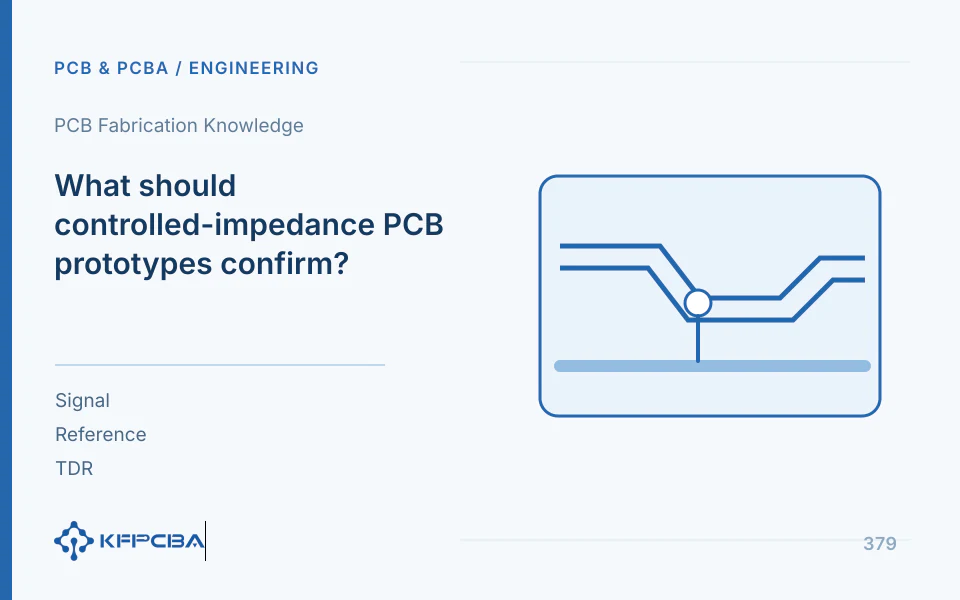
What should controlled-impedance PCB prototypes confirm? Nets, stackups, and test coupons

Controlled-impedance PCB purchasing must map target nets, actual layer pairs, manufacturing geometry, and test coupons to one another. This article adds a TDR definition, a reflection-coefficient example, calibration and measurement-window tables, and an abnormal-result retest process. It explains single-ended and differential measurement boundaries so one passing coupon report is not substituted for complete interface verification.

Read Article
PCB Fabrication Knowledge

Two-, four-, or six-layer PCB prototypes? Compare by verification task

PCB layer count should follow component escape routing, continuous reference planes, power requirements, and verification tasks. Beyond comparing two, four, and six layers, this article adds a layer-reduction decision table and a two-option review process. It explains which nets, vias, and tests change with layer count, helping compare total redesign cost rather than bare-board unit price alone.

Read Article
PCB Fabrication Knowledge

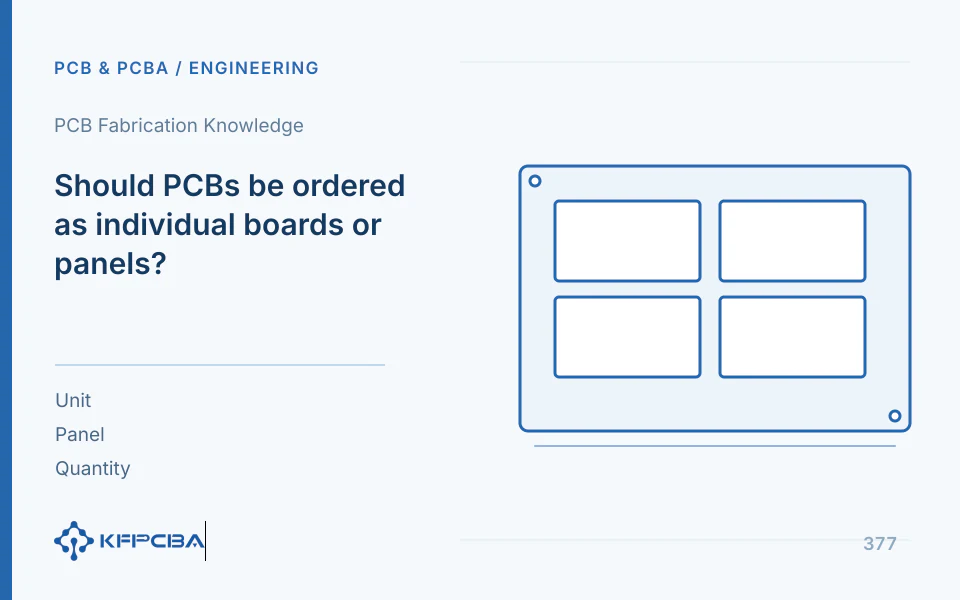
Should PCBs be ordered as individual boards or panels? Quantities, delivery, and pricing basis

PCB panel orders should distinguish accepted individual boards, delivered assembly panels, and fabrication panels. Beyond quantity definitions, this article adds defective-position counts, a panel-area example, and a responsibility table. It specifies process rails, coupons, marks, depaneling, and allowances so quotations, assembly, and acceptance share one delivery basis.

Read Article
PCB Fabrication Knowledge

How to accept incoming bare PCBs: dimensions, electrical testing, and issue records

Bare PCB acceptance should link approved drawings, board identification, lots, quantities, and measurements. Beyond the incoming checklist, this article adds a dimensional decision example, staged inspection, and evidence tables. It distinguishes electrical testing, TDR coupons, materials, and functional results, and outlines retesting, quarantine, and deviation acceptance so issues can be reproduced and closed.

Read Article
PCB Fabrication Knowledge

When does prototype PCB lead time begin? Engineering approval and arrival milestones

PCB lead time should distinguish file receipt, engineering approval, materials, fabrication, shipping, and acceptance. Alongside a milestone checklist, this article adds parallel tasks, a backward-scheduling example, an expedited-order responsibility table, and revision-hold records, showing how a requested arrival date becomes a confirmable schedule. Dispatch dates and logistics estimates must not be treated as commitments for accepted-board arrival.

Read Article
PCB Fabrication Knowledge

How to compare prototype PCB quotations: files, costs, and quantity definitions

Before comparing prototype PCB quotations, align the manufacturing revision, accepted quantity, materials/processes, inspection, and tax/shipping inclusions, then compare total costs. This article retains the public budgeting framework and adds a hypothetical quotation normalization example and process response table to identify setup fees, panel quantities, and exclusions, preventing a low unit price for a different configuration from being mistaken for lower procurement cost.

Read Article

PCB knowledge: find the engineering information you need now

From fabrication files and PCB structures to assembly, material supply, design, and acceptance. Choose a category by service or open a specific topic from the illustrated list.

Apply the guidance to a real project

Compare PCB fabrication, PCB assembly, and electronics design. For a specific decision, browse the engineering topic library. Project files, standards, and acceptance conditions govern the engineering review.

Discuss available requirements
PCB / PCBA · PROJECT ENQUIRY

Does Your Project Need PCB Fabrication, Assembly, or Box Build?

Tell us the product use and which files are available. We can define the next engineering step even when the data package is not complete.

Call UsWhatsAppRequest a Quote