
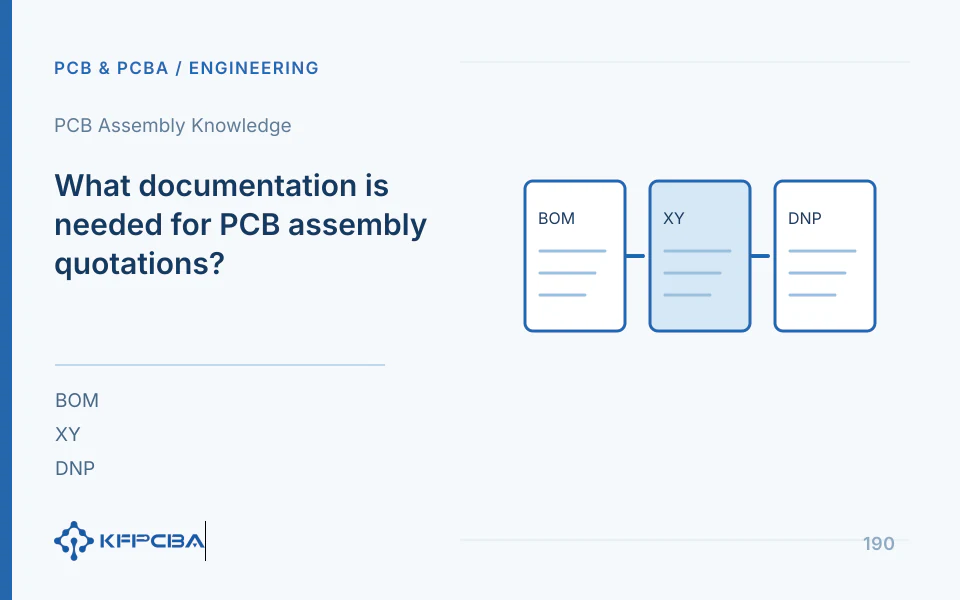
PCB assembly quotation documentation: how inquiry inputs produce comparable quotations
Inquiry documentation is more than Gerber, BOM, and CPL files. Align revisions, manufacturing scope, material supply, DNP, testing, and quantities to compare total prices and lead times. Incomplete designs can list missing items first, but gaps do not authorize factory substitutions or omitted testing by default.
Core data and consequences of missing items
| Documentation | Fields to specify clearly | Missing Items Impact |
|---|---|---|
| Fabrication Package | Copper/solder mask/legend/outline, hole attributes and layer spans, stackup, board thickness, copper weight, and surface finish | Panel Review, Panelization, and Soldering Conditions |
| BOM | Reference designators, per-board quantities, complete manufacturer part numbers, packages, DNP, and substitution authority | Purchase Price, Material Shortage, and Misassembly |
| Coordinate | Reference designators, X/Y, units, side, angle, and origin | Positioning, mirroring, first article direction, and preparation |
| Assembly Drawing | Polarity, special parts, through-hole component height, securing/wires, and depanelization | Process route, fixtures, and post-assembly |
| Program/Test | Firmware configuration, verification, test cases/limits, and fixture/software responsibilities | Programming, inspection coverage, development charges, and cycle time |
| Order Conditions | Quantity, application, material packaging, material readiness, packaging reports, and target lead time | Setup fees, inventory liability, and scheduling |
Example BOM fields for an executable quotation
| Designator Example | Board Quantity | Procurement Status | Required Additions |
|---|---|---|---|
| U1 | 1 | Designated original manufacturer part numbers | Complete ordering suffixes, packages, and MSL documentation |
| R1/R2 | 2 | Approved alternatives allowed | Resistance, tolerance, power rating, dimensions, and substitution rules |
| J1 | 1 | Customer-supplied | Packaging, pins, and component-height drawing |
| R10 | 0 | DNP No Assembly | Retain reference designators consistent with CPL/assembly drawings |
This table demonstrates fields without actual procurement models. Check consistency between reference-designator sets and quantities; do not delete DNP parts from the BOM while retaining their coordinates, which invites conflicting revision interpretations. Size labels such as 01005/0201 must state imperial or metric convention and actual length/width, not just the code.
How to avoid ambiguity in two-sided coordinates
Confirm CAD export format, origin, units, side, and rotation reference, and state whether the bottom side is already mirrored. Engineering checks polarity against assembly drawings and first articles; do not force every software package's coordinates into one angle convention. PCB artwork also needs material, board-thickness, and finish notes; Gerber Job can carry related manufacturing information.
Quotation comparison examples
Even for the same 100 boards, customer-supplied full reels versus loose parts, single-sided SMT versus through-hole-inclusive assembly, and visual-only inspection versus functional testing involve different setup and labor. Request separate charges for materials, PCB fabrication, assembly, stencils/fixtures, firmware/testing, and packaging, identifying reusable items on repeat orders rather than comparing only total unit prices.
Engineering responses should include documentation gaps, revision freeze, manufacturing routes, procurement and substitution authority, testing/reports, itemized costs, and delivery milestones after material readiness. Confirm the order window only after customer data is sufficient for review.
Resolve the open decisions before placing the order
Gerber Data: check bare-board file functions and hole attributes.
Supplier Responsibility: define boundaries for consigned, procured, and mixed material supply.
PCBA services: Define the full order scope. · PCBA Assembly Knowledge
Engineering reference | Gerber Job files: manufacturing attributes and package consistency. A basis for methods and selection; not evidence of KFPCBA capabilities
Engineering reference | SMT packages and assembly methods: pads, stencils, and thermal processes. A basis for methods and selection; not evidence of KFPCBA capabilities
Use reference designators and quantities to check whether the BOM is executable
The following documentation-checking method was compiled by the author. BOM reference-designator sets should expand into actual assembly objects, with per-board quantities matching the expanded count; one designator cannot belong to two rows of different materials. Retain DNP locations and define variants, with consistent treatment of unpopulated components in the CPL. Complete ordering suffixes determine package, temperature grade, or packaging; a chip-family name alone is insufficient.
| Verification | Executable Output | Conflict Resolution |
|---|---|---|
| Designator and Quantity | Itemized part list and single-board quantities | Design must confirm; extra coordinates do not authorize placement by default |
| Part Number and Package | Complete part numbers, libraries, and manufacturer drawings | Confirm suffixes; do not independently select approximate models |
| DNP and variants | Version and assembly status for each part number | Close discrepancies using the approved deviation table |
| Supplier Ownership | Consigned, procured, substituted, and excess materials | Mark missing items as pending confirmation; do not assume all materials are procured |
Coordinate files must allow independent direction verification
Choose several components with explicit polarity and compare origin, X/Y, side, and angle to confirm bottom-side mirroring rules. Mark pin one, diode orientation, and connector viewing direction in assembly drawings rather than asking operators to infer them from silkscreen. Package substitutions may change picking and rotation and require rechecking even if reference designators remain unchanged. TI's package directory routes users to relevant documentation; actual orientation and dimensions come from the current part number.
Quantity calculation example: 100 boards using 2 units of a component per board require 200 units net. Assuming 10 additional units are approved for trial production and losses, the planned quantity is 210; the extra quantity is an assumption in this example, not a universal loss allowance. If minimum packaging forces purchases above 210 units, the quote must identify actual procurement, line-issued quantities, surplus materials, and inventory ownership rather than treating all excess purchases as consumed.
Confirm quote inclusions using the status table
| Work | Must Be Clearly Stated | Available Status |
|---|---|---|
| Bare PCBs and components | Specifications, quantities, brand part numbers, and procurement units | Included, customer-supplied, pending confirmation |
| Engineering and Stencil | First article, program, version, and reuse conditions | Included, charged separately, or not applicable |
| Post-Soldering and Assembly | Through-hole, wire harness, mounting, and panelization | Specify by Process |
| Programming and Testing | Firmware source, test cases, fixtures, and per-board execution | Included, billed separately, customer-executed |
| Packaging and Report | Delivery format, records, and tax/shipping | Clarify by Order Scope |
Blank fields do not mean included. Ucamco explains that Job conveys manufacturing features but allows partial implementation, so a Job file still requires checks that materials, board thickness, finishes, and special requirements were actually populated and accepted. Technical files and commercial quotes should reference the same revision manifest; budget assumptions cannot directly support scheduling unless converted into formally approved conditions.
How to release two assembly variants sharing one BOM
Engineering example: a base version omits the wireless module, while a connected version adds the module and antenna connector. Beyond BOM DNP settings, check CPL, firmware, identity writing, and functional test cases. Functions absent from the base version cannot be listed as passed, while the connected version requires corresponding test support. Release a master file manifest and variant-difference table, quoting quantities and reusable setup separately rather than using color as the sole identifier in one BOM.
Engineering responses should tell procurement what is missing, what can start, and which step requires freezing. Update materials and costs for later substitutions or quantity changes, retaining traceable original quotation assumptions. Initial inquiries need not include a complete test specification, but must describe available documentation and target delivery; formal orders define actual coverage and responsibilities.
Source material and applicable scope
- Ucamco, Gerber Job; the public version page does not specify a revision number; checked 2026-10-17; sections: manufacturing documentation and partial implementation notes. Supports manufacturing information such as board thickness, materials, and finishes, and format-support boundaries; does not replace supplier input agreements.
- Texas Instruments, SMT & packaging application notes; directory page does not state a version; checked 2026-10-17; sections: QFN, BGA, Leaded packages, General packaging information. Supports routing to package and thermal-process documentation.
What does PCB assembly cost per board, and why do quotes differ for equal solder-joint counts?
Solder-joint count reflects only part of assembly work. BOM prices, single-/double-sided placement, package support, through-hole/subsequent soldering, programming, and calibration may differ; a manufacturing-only quote cannot be compared directly with one including materials and functional testing.
Quotation terms depend on the approved files, quantity, material supply, tests and delivery requirements.
Prepare a structured RFQ or use the short inquiry form.
Compare costs and verification under the same conditions
Itemize one-time setup, per-board materials, per-board assembly, programming/testing, mechanical work, and taxes/freight. State whether stencils and fixtures can be reused, give complete original manufacturer part numbers and surplus-material ownership, and specify actual operating states covered by testing.
View services and configurations related to this question or Request a project quotation. For initial discussions, describe the intended use, available documentation, and expected quantity.
Related procurement and acceptance Q&A
What does PCB assembly cost per board, and why do quotes differ for equal solder-joint counts?
A placement-only rate does not describe a complete assembly quotation. Compare the same released revision, material-supply model, accepted delivery quantity, inspection and test scope, and delivery terms. Ask the supplier to identify setup and reusable charges, materials, assembly, tests and logistics separately; inclusion depends on the agreed quotation. Compare assembly cost items and quote inclusions.
See: What does PCB assembly cost per board, and why do quotes differ for equal solder-joint counts?
How should an inquiry specify customer-supplied key chips and procured general components?
Mark supply responsibility, complete part number, packaging, and substitution authority for each item in the same BOM, sharing quantities and revisions; quote material procurement separately from assembly/testing.
View: Core Documentation and Consequences of Missing Items
Is deleting DNP components from the BOM sufficient?
Retain reference designators and mark them unpopulated, consistent with CPL and assembly drawings. Deleting entries while retaining coordinates creates conflicting revision interpretations and incorrect-placement risks.
Must double-sided pick-and-place files specify mirroring and angles?
Specify origin, units, side, and rotation reference, including whether the bottom side is already mirrored. Check against assembly drawings and first articles rather than applying one angle convention to all software.
View: How to avoid ambiguity with two-sided coordinates
How can I identify reusable setup charges in small-batch quotations?
Separate materials, PCB fabrication, assembly, stencils/fixtures, programming/testing, and packaging, stating repeat-order reuse conditions. Equal quantities still require aligned comparison when loose parts, double-sided assembly, or test scopes differ.
Five-minute RFQ file release check
Before sending an RFQ, open the exact archive that the supplier will receive. Check that the fabrication files, assembly drawing, BOM and placement export all name the same board revision and variant. A filename is not enough: a late BOM correction can leave the placement export on an older build.
- Pick three reference designators, including one polarized part and one bottom-side part. Confirm each appears with the same fitted/DNP decision in the BOM, drawing and placement data.
- Identify the coordinate origin, units, rotation convention and whether bottom-side data has already been mirrored. Flag any unknown convention for first-article confirmation.
- Count the requested accepted assemblies separately from bare boards supplied or boards started. State who provides spare components and boards for loss, setup and rework.
- Attach the test procedure or mark it as pending. Name the firmware revision and programming responsibility when applicable.
If a field is unknown, label it “pending clarification” and ask for a conditional quote. Do not silently let two suppliers assume different scopes. KiCad's placement-file documentation is one example of why design variants and omitted footprints need explicit review; other CAD tools may export differently.
RFQ handoff: send one revision
Attach the released BOM, placement export, fabrication package and a list of unanswered questions to the engineering RFQ. State the accepted quantity and material supply model so a quotation can name its exclusions.