
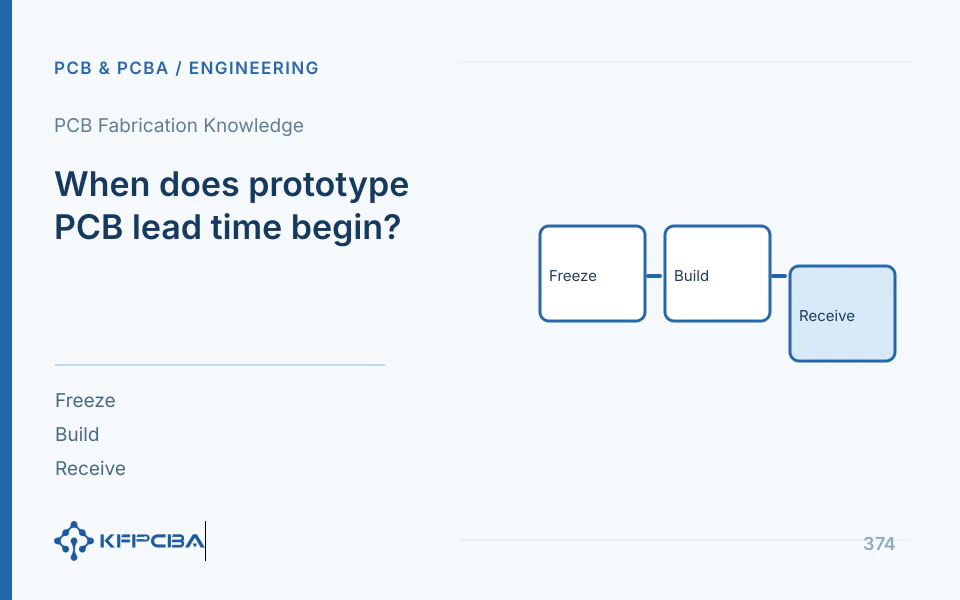
Define the start and finish before asking how many days delivery takes
State prototype PCB lead time as specific milestones: which file revision is approved, whether materials are secured, when production begins, when boards ship, and their expected arrival. If stackup, hole, or impedance questions remain after the initial upload, that upload is not automatically the production start. Separate dispatch, customer receipt and acceptance of conforming boards.
| node | Close Condition | Records to retain |
|---|---|---|
| Document Receipt | Complete same-version file package received | File directory, version, and missing item list |
| Engineering Approval | Stackup, hole, compensation, and substitution questions answered | Approved drawings, issue list, and approver |
| Materials and Scheduling | Specified materials available and production arrangements confirmed | Material status and agreed start conditions |
| Manufacturing and Inspection | Complete order processes and agreed inspections | Exception Handling and Release Documentation |
| Shipment and Arrival | Packaging, shipment, and receipt method clearly defined | Dispatch date, logistics information, and receipt records |
Four conditions that can change the schedule
Specified laminates, complex hole structures, special reports, and unfrozen revisions can all change fabrication arrangements. The fabricator should assess the impact; other suppliers' turnaround times are not this company's commitments. First check Document Completeness, then review Material preparation and substitution; for complex boards, also submit the hole drawing and inspection scope.
What to ask for expedited inquiries
- Does expediting apply to engineering approval, production, or shipping? Must the order arrive in one shipment?
- Which materials and processes are acceptable? Which substitutions require renewed verification?
- Can agreed inspections and reports be delivered on the same schedule? Reduced acceptance scope must not be the default expediting method.
- If a new revision is submitted after production starts, how will the old revision be handled and the new revision rescheduled?
Allow receiving and verification time when scheduling regional projects backward
For pickup near Shenzhen and delivery to Dongguan, Guangzhou, or elsewhere, verify receiving methods and shipping arrangements separately; no universal same-day guarantee is provided. Project owners should schedule arrival, incoming inspection, assembly, and prototype verification as distinct tasks. If problems arise, preserve board identification, revision, and measurement evidence before deciding on rework or refabrication.
Submit Prototype Quote, specify the requested arrival date and latest acceptable date, identifying engineering conditions that cannot change. After selecting Prototype Reference Configuration, establish the agreed lead time from the record of closed documentation items.
Data Basis:Engineering reference | Gerber manufacturing data: layer functions, drilling, and attributes, checked on 2026-10-05. Used for the corresponding file, structure, or material descriptions in this article. The procurement checklist is a communication method, not a statement of universal fabrication capability or delivery commitments.
Related procurement and acceptance Q&A
Does fabrication lead time begin with the first PCB file upload?
Not automatically if engineering issues remain open. Specify the approved revision, material readiness, and scheduling milestones, recording each prerequisite's closure.
See: Define the start and finish before asking how many days delivery takes
Which conditions must not be removed by default for an expedited order?
Specify materials, processes, inspections, and reports; reduced acceptance scope is not the default. State separately whether expediting applies to approval, production, or shipping.
See: What to ask in an expedited-order RFQ
What happens to the original lead time if Gerber files change after production begins?
First confirm disposition of the old revision, approval of the new revision, and rescheduling. The original order milestones do not automatically cover artwork changes.
See: What to ask in an expedited-order RFQ
Is a supplier's dispatch date the date the customer receives accepted boards?
Dispatch, transport, receipt, and acceptance are separate milestones. Regional backward scheduling also needs time for incoming inspection, assembly, and prototype verification; confirm shipping arrangements separately.
See: Allow receiving and verification time when scheduling regional projects backward
Can “as soon as possible” alone produce an actionable schedule?
Provide the requested arrival date and latest acceptable date, identifying fixed engineering conditions. Milestones can be reviewed once files, materials, and inspection scope are defined.
Backward schedule arrival using parallel and serial relationships
First identify when accepted boards are actually needed for assembly or testing, then schedule incoming inspection, shipping, fabrication, and engineering closure backward. Material preparation and engineering approval may run concurrently, or material procurement may have to wait for grade approval; neither adding all durations nor assuming complete overlap is valid by default. Record each task's owner, prerequisites, estimated duration, and confirmation status.
Suppose engineering approval takes 1 working day and specified material readiness takes 2 working days, and these can run concurrently, followed by 3 working days of fabrication, 1 of transport, and 0.5 of incoming inspection. From the point when complete files and task prerequisites are available, estimated duration is max(1,2)+3+1+0.5=6.5 working days. If material ordering must await engineering approval, it becomes 7.5. All times are scheduling examples, not company turnaround or shipping guarantees.
| Reverse-Ordered Fields | Entry Method | Closure Evidence |
|---|---|---|
| Requirement Endpoint | Date and Time When Qualified Boards Are Ready for Assembly | Project manager confirmation |
| Production Start Point | Approved version, materials, and production conditions | Engineering issue ticket and schedule response |
| Shipping | Dispatch window, method, destination, and receiving hours | Logistics Arrangement and Signature Interface |
| Acceptance | Inspection scope, personnel, tools, and exception handling | Incoming Inspection Tasks and Records |
Record holds for revisions and items awaiting approval
Create separate issues for incomplete files, unanswered engineering questions, pending material substitutions, and customer revisions. Record when each is raised, the responsible contact, responses, and closure time. This identifies which prerequisite extended the schedule and whether the original production start remains valid. “ASAP” in a chat cannot replace actionable milestones.
When new Gerber files arrive after production starts, first determine the old revision's production stage, disposition of work in progress, and reusable materials, then approve the new revision. Review the new schedule against explicit restart conditions; do not extend the earliest upload date indefinitely. Document old-revision disposition, new-revision effectivity, and schedule impact to prevent both revisions circulating simultaneously.
Expedite Priority Resolution of True Critical Path Items
If specified material availability is the longest prerequisite, saving a day in transport may not recover the overall schedule. Identify the critical path first, then compare material-substitution review, partial shipments, early delivery of verification quantities, and alternative shipping methods. Every substitution needs performance review and approval; expediting does not authorize skipped inspections or reduced technical requirements.
A partial-delivery plan should state the first shipment's accepted quantity, the verification tasks it enables, remaining shipments, and reports. Receiving a few boards without required coupons or material records may still leave the task blocked. Define first-shipment usability by verification inputs, not merely dispatch.
Include post-arrival preparation in the project plan
Arrange receiving hours, holidays, contacts, package-opening conditions, and inspection tools in advance. After logistics receipt, count boards, check revisions, and perform agreed inspections; allow time for quarantine, retesting, and communication if issues arise. Record transit estimates separately from agreed delivery milestones; a logistics-system display is not an engineering commitment.
The final schedule should have four columns: target, current forecast, confirmed milestones, and open risks. Record the reason and affected tasks for every update so the team can adjust assembly and testing. Define production, shipping, and acceptance responsibilities separately; use the same method across cities.
Source material and applicable scope
- Ucamco, “Gerber Format — Official Gerber Format Website”; online webpage with no fixed revision identified; checked on 2026-10-18; relevant sections cover Gerber layer files, attributes, and Job file responsibilities. Supports only manufacturing graphics and semantic inputs. The quotation, scheduling, acceptance, and collaboration tables below are this site's engineering procurement recommendations, not universal pricing or service commitments.