
Prototype Phase
First build representative acquisition, actuator, or display channels and check analog inputs, loads, and cleaning/coating boundaries; link prototype calibration and actual-interface test records to the same revision.
From analog acquisition and control drives to human-machine interfaces, focus on low-level signals, component traceability, and board-level functional validation; schedule prototype validation separately from volume outgoing tests.
Request Medical Board Assembly →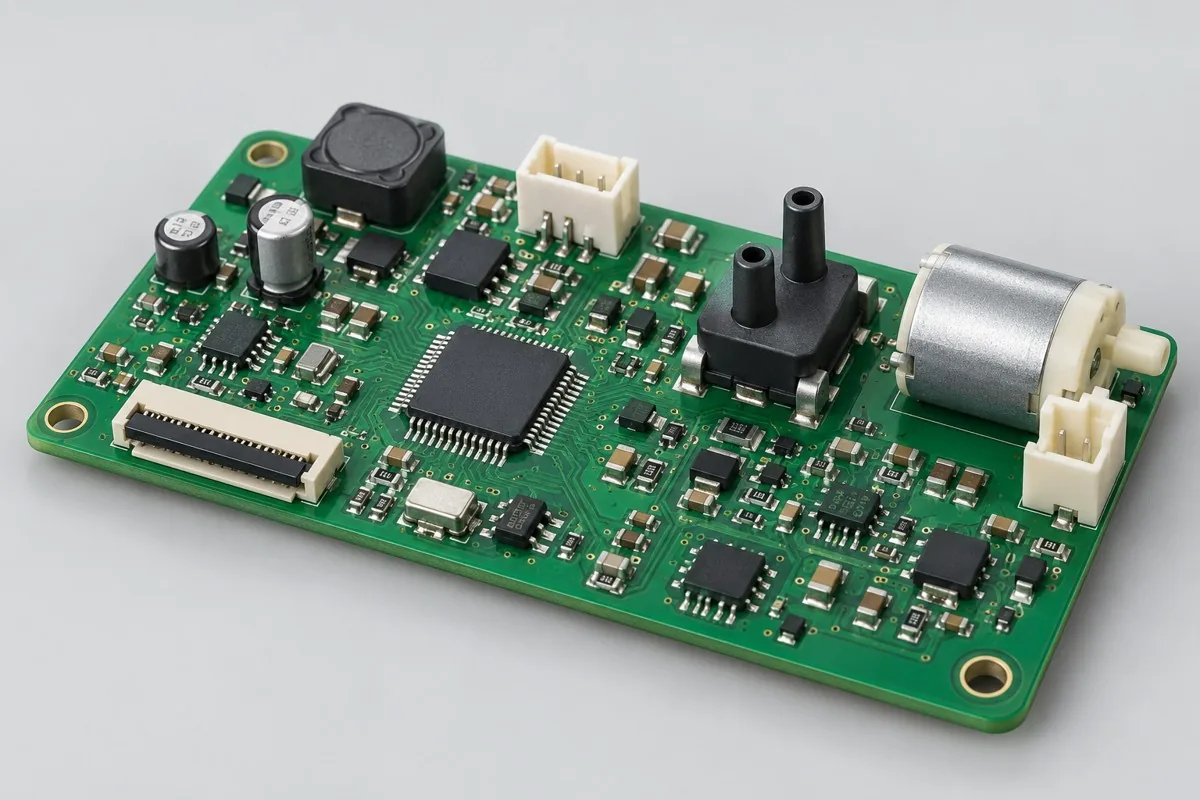
| Project Direction | PCB Manufacturing and Layout Focus | PCBA assembly and testing highlights |
|---|---|---|
| Monitoring and analog acquisition board | Low-noise signal chains, analog ground and reference supplies, guard rings, and sensitive-input cleanliness | Sampling channels, zero/gain adjustment, and calibration-data programming; batch or individual-board traceability |
| Pump valve and actuator control board | Motor power loops, load-switch cooling, and sensor-interface isolation | Pump/valve drive, stall protection, pressure feedback, and fault recovery |
| Display and interface boards | Display-connector positioning, ribbon-cable fastening, and button/indicator positions | Checks of display/buttons/buzzer, communication interfaces, and firmware revisions |
| Review Items | What specific inputs are provided | How to confirm results |
|---|---|---|
| Analog Performance | Measurement range, resolution, noise, calibration points, and fixture wiring | Record raw values and calibrated results by channel; apply customer-defined limits |
| Cleaning and environment | Residues, coating regions, cleaning compatibility, and humid operating conditions | Validate cleaning/coating effects on sensors, connectors, and calibration |
| Materials and traceability | Critical part numbers, substitution authority, lot numbers, individual-board SN, and retention period | Record material batches, software/test revisions, and exception handling |
First build representative acquisition, actuator, or display channels and check analog inputs, loads, and cleaning/coating boundaries; link prototype calibration and actual-interface test records to the same revision.
Convert measurement ranges, calibration points, material batches, and first-article thermal processes into repeatable steps; agree on calibration-data programming, critical-material substitutions, and SN records.
Deliver against approved test limits, linking critical-material batches, firmware checksums, and acquisition/drive results; assign uncovered complete-device validation items to the corresponding responsible party.
For medical electronics projects, in addition to Gerber, drill files, BOM, pick-and-place files/CPL, and assembly drawings, include operating environment, actual interfaces/loads, enclosure and harness drawings, target quantity, and the test limits above. If commissioning programming or calibration, add software revision, checksum, fixture wiring, and programming permissions.
Assign responsibilities separately for complete medical-device performance, certification, and environmental testing; acquisition, calibration, and assembly records here cover only the agreed board-level scope.
View specific fabrication products by board-level task, or arrange a joint PCB fabrication and assembly review with complete information.
Engineering reference | QFN and SON assembly: thermal pads, printing, and solder joint verification: QFN/SON pad, stencil, and measured thermal process methods; not company capabilities.
Engineering reference | Packaging PCB fabrication files: units, layer order, and engineering notes: methods for PCB fabrication, hole layer spans, and file semantics.

Tell us the product use and which files are available. We can define the next engineering step even when the data package is not complete.