Engineering Reference Configuration
Wireless gateway PCB assembly: configuration, testing, and deliverables
The following adjustable engineering configurations support material, functional, and process review; they are not stocked models or commitments to current production-line capabilities. Approved fabrication documentation and order acceptance requirements govern.
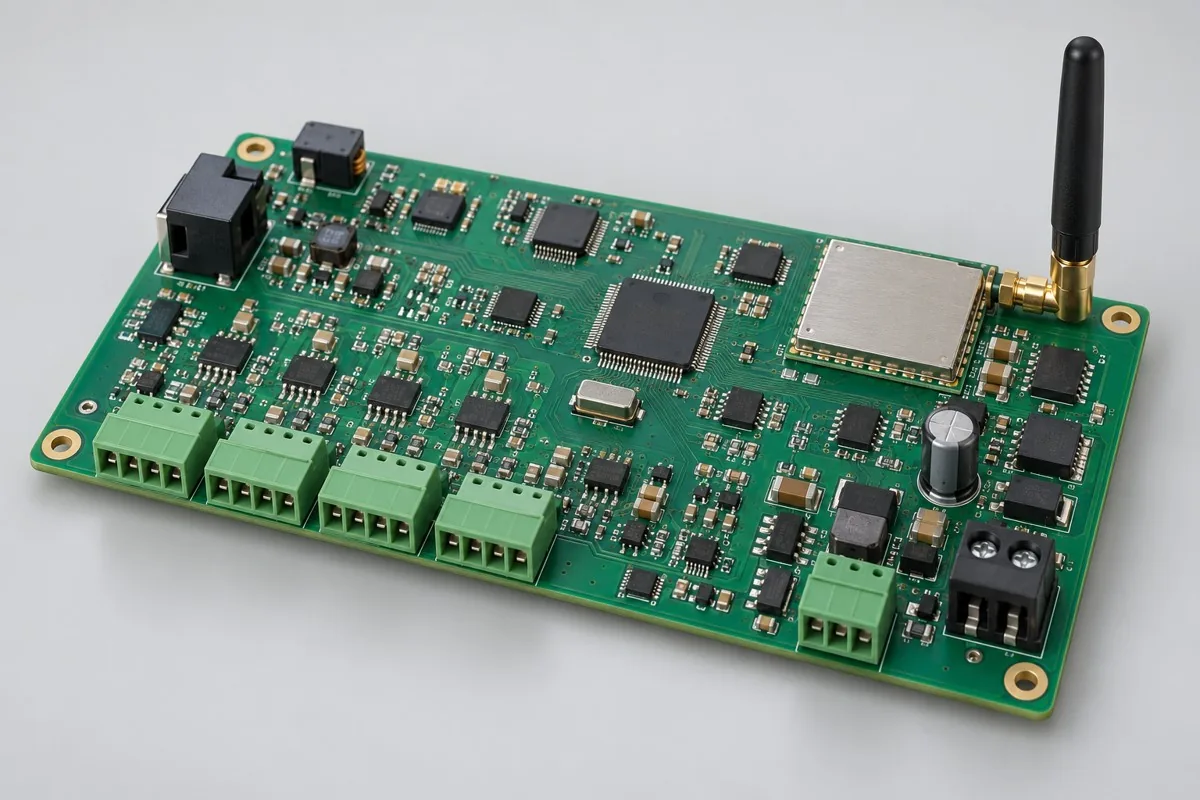
Wireless measurement gateway assembly supports manufacturing/procurement for 4 sensor channels + wireless reporting. Confirm MCU + analog front end + module, RS-485 maintenance, Wi-Fi/cellular options, and 4-layer FR-4 separating antennas/sampling. Compare double-sided SMT → terminal secondary soldering → antenna connection → calibration/networking and sampling/offline buffering/reconnection/RF-installation acceptance. Distinguish gateway + calibration table + identities + communication from wired/wireless, board-only/antenna/enclosure delivery so quotations match use. RFQ reference:BOM · bare board · material supply
Reference specification and configuration options
| Options | Reference Configuration |
|---|---|
| Power and Logic Domains | 24V industrial input; independent wireless power |
| Functional Module | 4 channel sensor sampling + wireless data reporting |
| Core Components/Architecture | MCU + analog front end + wireless module |
| Interface and Channels | RS-485 maintenance; Wi-Fi/cellular module options |
| Board Layers and Material Options | 4-layer FR-4; separate antenna/sampling regions |
| Component types | SMD MCU/ADC, wireless modules, through-hole terminals |
| Assembly Route | Double-sided SMT → terminal secondary soldering → antenna connection → calibration/networking |
| Material Supply Scope | Regional module/antenna models specified; sensor-interface parts may be sourced |
| Firmware and Parameters | Channel coefficients, reporting intervals, identity, network configuration |
| Test Focus | Sampling, offline buffering, reconnection, RF-installation effects |
| Deliverables | Gateway + calibration table + identity list + communication results |
| Configuration Limits/Options | Wired/wireless combinations; board-only or antenna/enclosure assemblies |
How much does wireless measurement gateway PCB assembly cost, and what is included?
Four analog front ends, modules, antennas, and interfaces affect costs. Itemize calibration, identities, networking, buffering, and reconnection. Antenna/enclosure assembly, cellular services, and platforms are separate. Compare identical concurrent sampling/transmission conditions.
Quotation terms depend on the approved files, quantity, material supply, tests and delivery requirements.
Prepare a structured RFQ or use the short inquiry form.
| Cost Item | Scope for This Configuration | Billing frequency and work scope | Procurement Verification |
|---|---|---|---|
| Bare PCB and core components | MCU + analog front end + module; 4-layer FR-4; antenna/sampling partitioning | Price according to actual bare-board/component purchase quantities; authorize critical components and substitutions individually | Regional module/antenna models specified; sensor-interface parts may be sourced |
| Placement and Post-Assembly | Double-sided SMT → terminal secondary soldering → antenna connection → calibration/networking | Feeder/program setup per lot; assembly priced per board, joint, or process as agreed, with counting rules specified | SMD MCU/ADC, wireless modules, through-hole terminals |
| Manufacturing Preparation | Review stencils, first articles, and support tooling against the actual assembly route | New stencils/carriers may be separate one-time charges; verify panelization, revision, and condition before reuse | Reduced quantities do not automatically eliminate first-article or feeder setup |
| Functional Support | Sampling, offline buffering, reconnection, RF-installation effects | Itemize test-method/fixture/script setup; agree execution charges per board, channel, or test duration | Separate supporting development from execution records for each board |
| Software and Parameters | Channel coefficients, reporting intervals, identity, network configuration | When firmware exists, distinguish file programming/verification from software development; omit programming without a firmware revision | Customer-approved files, parameters, and readback rules determine scope |
| Delivery and Change | Gateway + calibration + identities + communication; wired/wireless, board-only or antenna/enclosure delivery | Price accessories, retesting, and revision changes by approved work items; do not prefill fixed rates | Check BOM, tooling, programs, and acceptance revisions before reorders |
Should wireless measurement gateways use Wi-Fi or cellular?
Wi-Fi relies on site networks; cellular supports independent access but regional modules/services apply. Compare coverage, intervals, and operations before hardware costs; do not fold service fees into board prices.
| Comparison Metric | Current Conditions | Factors Influencing Procurement Decision |
|---|---|---|
| Manufacturing Delivery | Double-sided SMT → terminal secondary soldering → antenna connection → calibration/networking | Produce boards/assemblies per BOM and assembly drawings; this does not establish that every system function passes |
| Functional Acceptance | Sampling, offline buffering, reconnection, RF-installation effects | Compare unit prices after defining test stimuli, limits, accessories, and records; review missing test inputs first |
| Configuration Options | RS-485 maintenance; Wi-Fi/cellular options; 4-layer FR-4; antenna/sampling partitioning | Confirm circuit/program compatibility before reviewing assembly and test costs for interface, stackup, or component changes |
| Delivery Scope | Wired/wireless combinations; board-only or antenna/enclosure assemblies | Complete-system accessories, application development, and project verification are not automatically included in board assembly |
Can four-channel gateways mix voltage and current sensors?
Define each front end, electrical range, and calibration. Identical terminals are not universal inputs. Transmit pulses may disturb analog readings; record transmit/quiet sampling, not standalone calibration alone.
- List required 4 sensor channels + wireless reporting, distinguishing build-to-print, adjustments, and new development.
- Freeze complete MCU/front-end/module parts, RS-485/Wi-Fi/cellular, and 4-layer FR-4 partitioning. Divide consigned/sourced materials by regional module/antenna models and optionally sourced sensor interfaces.
- First articles check double-sided SMT → terminal secondary soldering → antenna connection → calibration/networking and coefficients/intervals/identity/configuration. Agree verification for supplied software; review development separately.
- Make sampling/offline buffering/reconnection/RF effects executable acceptance with stimuli/limits/records, fixture ownership, per-board work, and rework retests.
- Confirm gateway + calibration + identities + communication and wired/wireless/board-only/antenna/enclosure scope; compare equal quantities/accessories/tests and freeze orders.
Applicable uses and situations requiring separate review
Wireless sensor networking, equipment-monitoring gateways, industrial reporting.
Compare FPGA acquisition for synchronous high-speed multichannel needs. No-data-loss projects need buffer capacities/retransmission rules rather than default module configuration.
Assembly Challenges for This Product
Transmit-current pulses may couple into analog sampling; check first articles transmitting and quiet. Install antenna solder joints, coax snaps, and terminals in steps; post-hoc shielding does not fix analog/digital return paths.
Structural, thermal, and configuration trade-offs
Modules reduce RF design but need antenna clearance; separate antennas aid mechanics but add cable assembly. Validate power/heat jointly under simultaneous transmission/acquisition.
Product-specific test matrix
| Test stage | Inspection/Functional Methods | Acceptance Record |
|---|---|---|
| Input Range | Inject zero/midpoint/endpoint signals per channel | Channel Coefficient and Measurement Result |
| Networking/Recovery | Network loss, buffering, reconnection, duplicate packets | Device identity, event logs, data consistency |
| Interference Status | Compare sampling under transmit or silent conditions | Two state differences and antenna installation versions |
Defect Handling and Acceptance
Investigate analog, power, and protocol causes for channel drift, module resets, and packet loss; these symptoms alone do not identify the failed layer. Retain offline-data handling results; network access alone does not cover sensors.
Wireless acquisition gateway PCB assembly: supply and revision control
Lock carrier/regional module versions and antenna connectors/lengths. Customers provide server addresses and controlled key-loading procedures; validate analog resistor substitutions for range/drift.
Prototype and production planning
Manual network setup and calibration may suit prototypes; define controlled identity loading and separate calibration/configuration records for production. Final tests use controlled servers and remove debug accounts.
Delivery Configuration
Gateway + calibration table + identity list + communication results. Wired/wireless, board-only or antenna/enclosure delivery.
Convert this configuration into a reviewable order
For gateways, check BOM, quantity, supply, conditions; add pick-and-place/CPL, DNP, assembly drawings. Programming needs coefficient/interval/identity/network files, rules, checksums. Calibration adds ranges/references, limits, parameter-writing rules. Price materials, double-sided SMT → terminal secondary soldering → antenna connection → calibration/networking, stencils/setup/carriers/equipment separately. Reapprove changes; agree delivery after kits/schedules.
| Required project inputs | Engineering Decisions Affected | Records/delivery as agreed in the order |
|---|---|---|
| Sensing and wireless link | List channel ranges/interfaces, wireless standards, intervals to define sampling fixtures/network equipment. | Record references, uploaded data, recovery; accept sampling/communication separately. |
| On-Site Power Supply | Define 24V limits, isolation options, protection assembly revision. | Link power checks to board IDs; projects provide surge-test specifications separately. |
Wireless measurement gateway PCB assembly FAQ
How much does wireless measurement gateway PCB assembly cost, and what is included?
Itemize sensor calibration, identities, antenna installation, and network recovery. Confirm the files, quantities, material responsibilities, test records, delivery destination, currency, taxes, shipping, and trade terms before comparing totals. Review the quotation scope.
Does gateway contract assembly include data SIMs and platforms?
Specify modules, antennas, identity programming, and network tests; agree service plans/backend separately. Include test-account-to-production-identity transitions in shipping procedures.
Why test offline buffering after successful connection?
Connection success does not prove data retention/reupload during outages. Record buffers, recovery, and samples to establish actual monitoring tasks.
Why retest sampling during wireless transmission?
Current pulses can couple into analog front ends; quiet-only calibration misses combined faults. Record both states and power conditions, stating whether costs cover these cases.
What is needed with consigned gateway antennas?
Lock regional modules, antenna models, cables, fastening, enclosure positions. Recheck combined networking/sampling after antenna/enclosure changes; matching interfaces do not establish interchangeability.
How should input-range tests enter gateway acceptance?
Inject zero/midpoint/endpoints per channel; retain coefficients/results. Provide inputs, configurations, and limits before first-article/per-board scope; price preparation separately. Without limits, review methods rather than claiming compliance from completed operations.
How should networking/recovery tests enter gateway acceptance?
Test outages, buffers, reconnection, duplicates; retain identities/events/data consistency. Provide inputs, configurations, and limits before first-article/per-board scope; price preparation separately. Without limits, review methods rather than claiming compliance from completed operations.
How should interference-state tests enter gateway acceptance?
Compare transmit/quiet sampling; retain state differences and antenna revisions. Provide inputs, configurations, and limits before first-article/per-board scope; price preparation separately. Without limits, review methods rather than claiming compliance from completed operations.
With customer software, how should gateway programming/development be priced separately?
Controlled content covers coefficients, reporting, identity, networking. Approved-file/parameter programming/readback are manufacturing; new logic/interfaces/algorithms require development. Itemize preparation, per-board programming, verification, failures; programming inclusion does not imply application development.
Must first-article, stencil, and setup charges be recalculated for repeat gateways?
The route is double-sided SMT → terminal secondary soldering → antenna connection → calibration/networking. Check SMT stencils/panels and through-hole/later-stage support/methods. Agree batch setup/first articles; reuse matching revisions/positions/condition only. Changed MCU/ADC, modules, terminals/interfaces require tooling and sampling/buffering/reconnection/RF-installation review before recurring charges.
How should gateway totals compare consigned critical and sourced remaining parts?
Create responsibilities from regional module/antenna models and optionally sourced sensor interfaces; confirm complete parts/quantity/packaging/leftovers. Consignment changes procurement only; double-sided SMT, terminals, antennas, calibration/networking, sampling/buffering/reconnection/RF effects remain work. Approve shortage/substitution/batch impacts; consigned unit prices differ from material-inclusive totals.
What needs retesting after gateway repair or supplemental orders?
Use change impact. Original items are sampling, buffers, reconnection, RF installation; records are gateway + calibration + identities + communication. Power/interface/analog/software changes need related tests, not joints alone. Align supplemental BOM/parameters/equipment; charge approved items/actual quantities without assumed free service or fixed turnaround.
Compare Other Products in This Category
- Millimeter-Wave Presence Detection Board: Radar antenna and housing impact.
- RF Transceiver Interface Board: RF link and shield connection.
- Multi-band wireless signal transceiver module: Related engineering reference; define frequency bands and interfaces for the actual project.
Return to high-frequency PCB assembly configuration comparison · Component Supply and Procurement · Testing and Delivery Scope
Material and Process Reference
- Engineering reference | SMT packages and assembly methods: pads, stencils, and thermal processes: a package/assembly method index only; not evidence that the product configurations on this page are models produced by KFPCBA
- Engineering reference | Moisture-sensitive component management: MSL, floor life, and reflow conditions: a basis for moisture-sensitive component management methods only; not evidence of KFPCBA equipment, qualifications, or order scope