
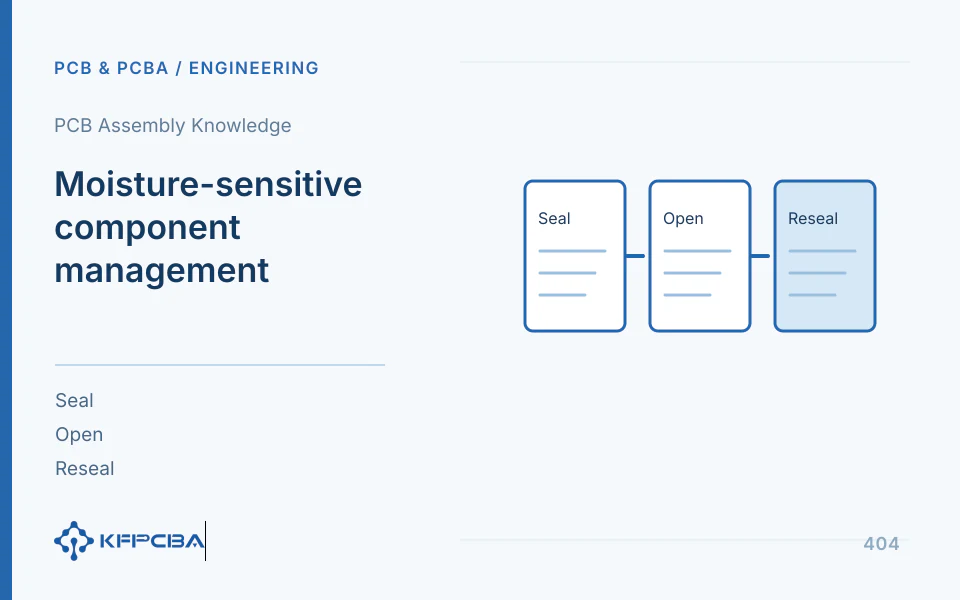
Production readiness for moisture-sensitive components depends on more than whether the bag is currently sealed. Assess full part number, package, MSL label, bag seal and humidity indication, accumulated exposure conditions, and planned thermal processes together. Resealing is a packaging operation, not an automatic erasure of previous exposure; oven settings also do not equal the temperature actually experienced by components.
What MSL management solves
Moisture absorbed by plastic-encapsulated and similar components can cause internal package damage during rapid heating. MSL describes sensitivity under specified classification conditions, not unrestricted storage in every temperature/humidity environment. J-STD-020 addresses moisture/reflow sensitivity classification, while J-STD-033 addresses handling, packaging, shipping, and use. IPC's public training overview confirms these topics and lists floor life, dry packing, and pause/reset management, without publishing complete numerical tables.
Allowed times, temperature/humidity conditions, and treatment methods must therefore come from applicable formal standards and component manufacturer documents. This page does not treat a course overview as the full standard or derive baking temperatures from MSL names. For old, loose, or unpacked customer-supplied parts, missing documentation itself requires action; remaining life cannot be inferred from appearance.
Use a time log to link opening and material return
| Event | Information That Must Be Linked | Judgments That Cannot Be Omitted |
|---|---|---|
| Incoming Material Receipt | Full part number, lot, package identifier, label, and humidity indication | Whether packaging meets receiving requirements and anomalies are quarantined |
| First Opening | Time, environment, quantity, and work orders used | Which exposure conditions and timing rules to adopt |
| Line Change or Material Split | Parent/child package relationships and quantity used | Whether exposure history transfers to every child package |
| Re-Sealing or Dry Storage | Entry time, environment, and packaging/equipment identifier | Pause or treat under approved conditions; do not independently reset the counter |
| Return and Reclaim | Original work order, remaining quantity, and cumulative history | Whether remaining allowable use can still be substantiated |
Timing is about retaining the same lot's history after every material movement, not choosing an attractive form. Reel splitting, retaping, and combining leftovers can break links. Do not simply merge different histories into a new lot number in records. If materials must be mixed, preserve each source and destination, and include the worst-case status in disposition review.
How to calculate cumulative exposure without distortion
Simple addition is valid only when environmental conditions meet established timing rules. Engineering example: in the same controlled environment, one reel is exposed for 2.5 hours in the morning, 1.5 hours in the afternoon, and 2 hours the next day. Recorded exposure is 2.5+1.5+2=6 hours. This 6 hours is a record total, not a standard allowance; continued use requires comparison with the component's allowance under applicable conditions.
If any interval exceeds approved environmental conditions, do not count it as ordinary hours or assume sufficiently long dry-cabinet storage resets history. Record the deviation separately and evaluate derating, recovery, or disposition under formal documents. Drying-equipment displays, calibration, and door-opening practices affect actual conditions; “placed in dry cabinet” does not establish which requirements were met.
The roles of dry storage and baking
| Scenario | Priority Data for Verification | Possible Outputs |
|---|---|---|
| Planned Short-Term Line Stoppage | Applicable storage/pause conditions and current history | Pause basis, entry/exit times, and remaining status |
| Exposure Conditions Exceed Approved Limits | Permitted component treatment and heat resistance of packages, carrier tape, and trays | Approved baking or other disposition work orders |
| Packaging damage or humidity indicator anomaly | Manufacturer receiving requirements and transport/storage history | Isolation conclusion and supplementary investigation requirements |
| Sensitive Materials or Special Components | Device-specific processing limitations | Separate process route; do not apply generic baking conditions |
Baking is not a universal remedy for storage deviations. Temperature and duration depend on the package, internal structure, plating, and packaging materials. Tape, reels, or trays may not withstand the component body's temperature; transfers from non-heat-resistant packaging also introduce ESD, orientation, and traceability risks. Confirm containers, loading, and timing conditions before treatment; retain equipment, temperature records, and material destinations afterward.
Include reflow and rework in the same management chain
Solder paste needs enough heat to form connections, while components have thermal-exposure limits; both must be met. Obtain solder-paste process recommendations, component reflow limits, and actual board temperature measurements separately. Large copper areas, shields, and high-thermal-mass parts change component and joint temperatures; empty-oven settings cannot serve as evidence for every board.
Before rework, reconfirm component status, local preheating, and effects on nearby parts. Assembled moisture-sensitive components remain controlled even outside their original packaging. Record assembly/rework thermal histories, specifying whether removed parts can be reused and nearby parts need reinspection. Passing post-rework function does not establish that every package remains internally undamaged.
Initial small-quantity validation and anomaly handling list
- Check original packaging labels, part numbers, and packages; align the rule revision with the product route
- Trial material issue, splitting, line transfer, and return; check that complete history follows the material
- Measure temperatures at selected locations on actual boards, focusing on thermal-mass differences and the most sensitive components
- Check applicable conditions and status of resealing materials, drying equipment, and baking containers
- If records have gaps, quarantine affected materials and preserve labels/samples before deciding on supplemental evidence or disposition
Method example: a returned BGA reel has only a “resealed” label and no previous opening time. Do not estimate remaining hours and release it directly. Check work-order issue/return records, line-side records, and environmental data. If history remains unestablished, follow the component's approved procedure. Closing the missing record as a process issue reduces repeat investigations on later orders. For related hidden-connection verification, see BGA Assembly Method.
Confusing Usage Issues to Verify
Can components with the same MSL share treatment conditions?
Not on classification alone. Check package, allowable reflow conditions, manufacturer restrictions, and packaging heat resistance. Shared MSL is one input, not coverage of other differences.
Can a normal humidity indicator card replace opening records?
No. The card reflects relevant packaging conditions, while opening history tracks floor exposure. Inserting a new normal indicator card does not restore lost history.
How to preserve complete history on split labels
During splitting, child packages should inherit the original part number, lot, parent-package identifier, and status at splitting, then record subsequent exposure separately. A newly printed label's time is not the lot's first opening time. If one reel serves two work orders, each route's issue, resealing, and return must be independently traceable. Leftovers with the same part number but different histories should not be merged by inventory quantity alone. After treatment, verify identification, orientation, quantity, and packaging to prevent mixing during baking or transfers. If the timing system fails, use controlled temporary records, then restore links and retain original evidence. Mark unsupported intervals as unknown for disposition under the applicable procedure; do not invent estimates merely to complete the form. Moisture management produces an explainable usage status, beyond a baking-complete label. When materials move from the warehouse to outsourced processes, transfer histories and treatment restrictions too. Continue management from actual records upon return; a change of responsible organization does not restart the clock.
Source material and applicable scope
- IPC, “IPC J-STD-020/033 Moisture-Sensitive Component Classification and Control”; webpage does not identify the standard revisions taught; checked on 2026-10-17; sections: course overview and training outline. Supports classification, floor life, dry packing, and rework topics, without providing the paid standards' time/temperature criteria.
Verify Assembly and Material Input · Determine First Article and Re-Inspection Records
Filled reel history across opening, shift change and return
Fictional 2026 training record, not a KFPCBA lot or a floor-life allowance. Lot L-EX-01 begins as a sealed reel of 100 parts. The entries show observed line-side hours only. An approved component-specific procedure must decide whether each dry-storage interval qualifies as a pause and how any unknown interval is treated; this table cannot release material by itself.
| Event and time | Package, quantity and location | Observed ambient interval | Known line-side subtotal | Record and decision |
|---|---|---|---|---|
| 5 Nov, 08:00 | Parent reel R-EX-01, 100; bag opened at line 1 | Start | 0 h | Record label, full part number, MSL, seal and humidity indication; link work order. |
| 5 Nov, 10:30 | R-EX-01, 100; entered cabinet DC-04 | 08:00–10:30 = 2.5 h | 2.5 h | Attach cabinet and environment logs. Pause qualification remains subject to the approved procedure. |
| 5 Nov, 12:00–13:30 | R-EX-01, 100; removed for line work, then returned to DC-04 | 1.5 h | 4.0 h | Retain both withdrawal and return times; a new bag or label does not reset history. |
| 6 Nov, 09:00 | R-EX-01 split into A-EX-01, 70 and B-EX-01, 30 | No new line interval recorded | Both children inherit at least the parent's 4.0 h line-side subtotal | Copy parent lot and status to both child labels; check overnight cabinet evidence. |
| 6 Nov, 10:00 shift handoff | A-EX-01 at line 1, 70 | 09:00–10:00 = 1.0 h | A: 5.0 h | Outgoing and incoming operators acknowledge the same reel ID and open time. |
| 6 Nov, 11:00 return | A-EX-01, 58 remaining after 12 used | 10:00–11:00 = 1.0 h | A: 6.0 h known line-side time | Record 12 consumed, 58 returned, packaging condition and destination. Do not label 6 h as remaining allowance. |
| 6 Nov, 11:00 exception | B-EX-01, 30 returned without a reliable location or environment log since splitting | Unknown | B: at least 4.0 h, plus unresolved time | Quarantine B, preserve labels and seek line/cabinet records; do not infer time from a new seal. |
Before using either child reel, compare its complete history with the exact component label, applicable handling revision and approved procedure. If a cabinet record, humidity condition or opening time is missing, keep the status unresolved and ask the responsible engineer to determine the disposition. Send available material labels and history with the SMT assembly input packet; the first-article record should identify the effective material lot and any approved treatment.
Source boundary for the worked record
Texas Instruments, Quality, reliability and packaging FAQs, moisture-handling topics; checked 2026-11-11. Supports the need for component labels, appropriate packaging and handling information; it does not define a pause, reset or release rule for the fictional exposure log. Read the primary source.