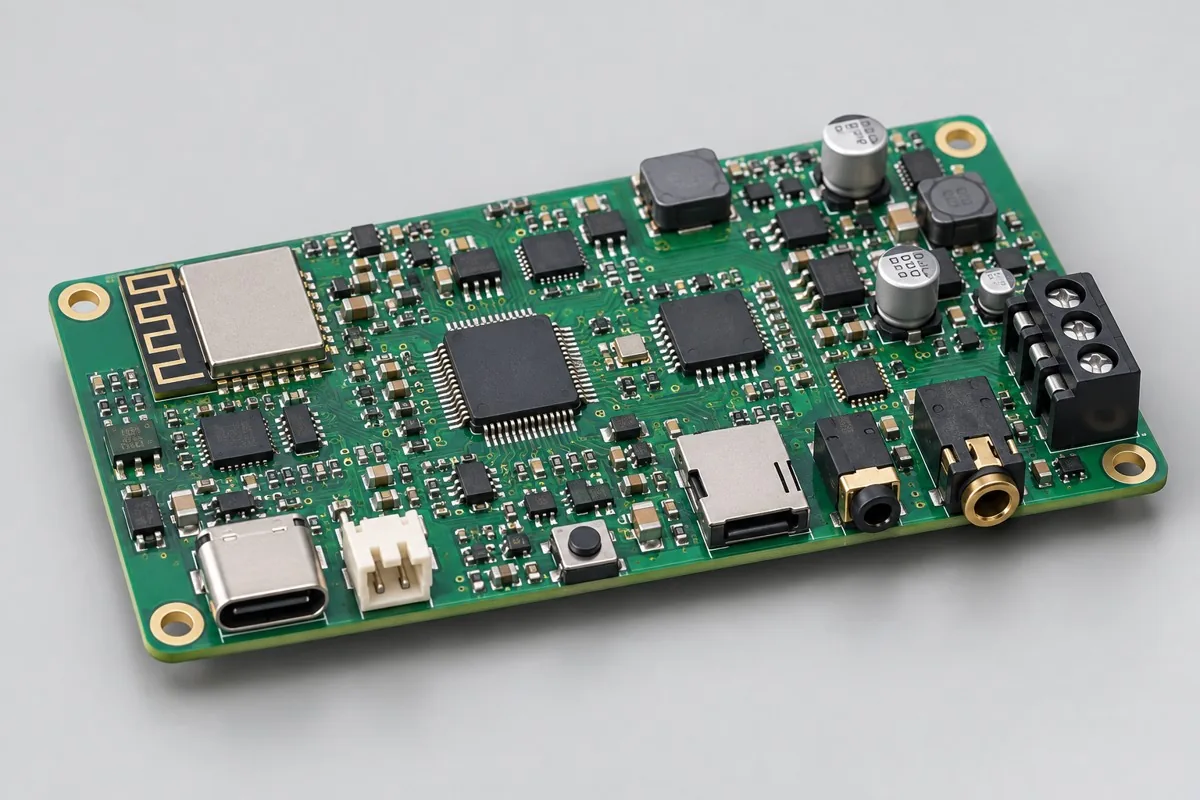
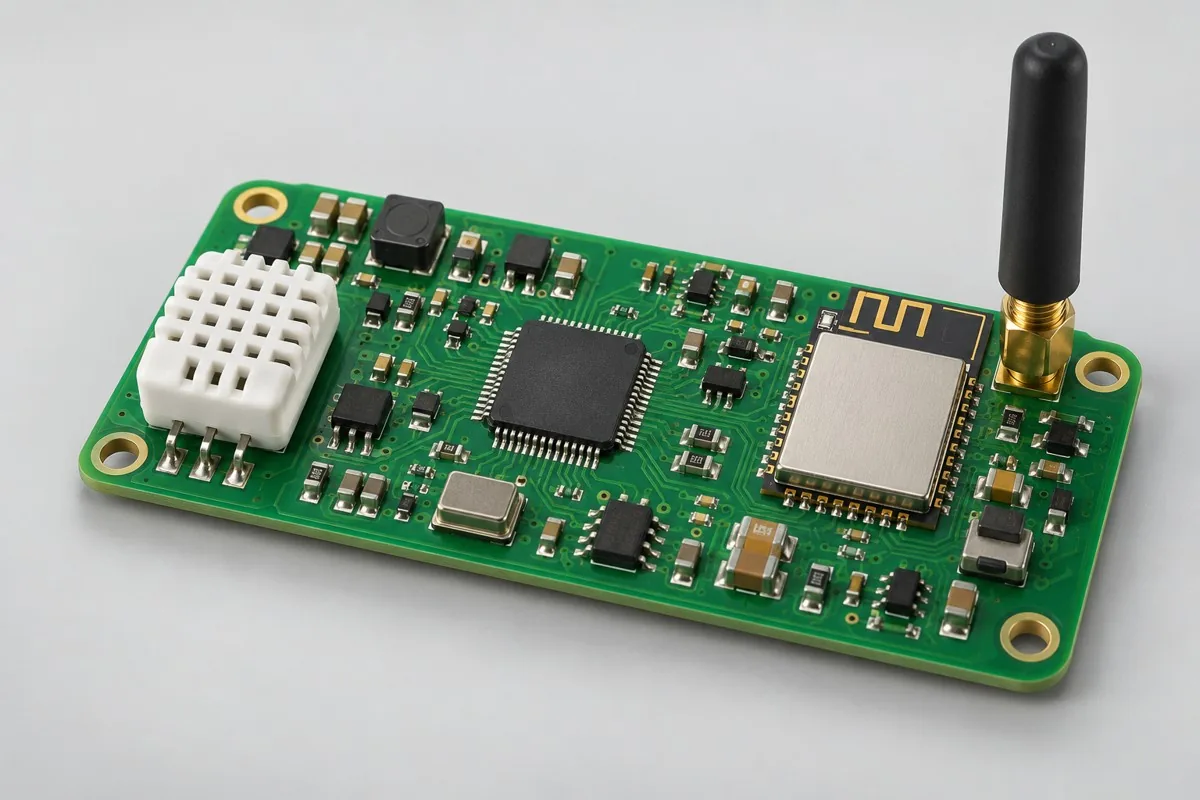
Engineering Reference Configuration
Smart-home PCB assembly: configuration, testing, and deliverables
The following adjustable engineering configurations support material, functional, and process review; they are not stocked models or commitments to current production-line capabilities. Approved fabrication documentation and order acceptance requirements govern.
Smart-home control board assembly supports contract manufacturing and procurement review for temperature/humidity, door-contact, and other sensing + local actuation control. First confirm low-power MCU + wireless module/SoC, I2C sensing, buttons, Wi-Fi/BLE options, and 2/4-layer FR-4 with antenna clearance and battery-connection regions. Then compare SMT → battery-connection installation → firmware → sleep/network testing scope and acceptance costs for sensor values, sleep/wakeup, network configuration, and disconnection recovery. This page distinguishes control board + identity/firmware records + state testing from sensing/actuation versions separated by BOM, helping assess whether quotations cover actual use. RFQ information reference:BOM · material supply
Reference specification and configuration options
| Options | Reference Configuration |
|---|---|
| Power and Logic Domains | Battery or 5V supply; 3.3V logic |
| Functional Module | Temperature/humidity, door-contact, and other sensing + local actuation control |
| Core Components/Architecture | Low-power MCU + wireless module/SoC |
| Interface and Channels | I2C sensing; buttons; Wi-Fi/BLE options |
| Board Layers and Material Options | 2/4-layer FR-4; antenna clearance and battery-connection regions |
| Component types | QFN/modules, SMD sensors, spring contacts/wire connectors |
| Assembly Route | SMT → battery-connection installation → firmware → sleep/network testing |
| Material Supply Scope | Locked sensor and wireless part numbers; customer may install batteries |
| Firmware and Parameters | Network configuration, reporting, low-power states, and device identity |
| Test Focus | Sensor values, sleep/wake, network provisioning, and disconnection recovery |
| Deliverables | Control board + identity/firmware records + state testing |
| Configuration Limits/Options | Sensing board/actuator board distinguished by BOM |
How much does smart-home control board assembly cost, and what does the quotation include?
Sensors, wireless modules or SoCs, battery connectors, and actuator outputs affect material costs. State whether network configuration, device-identity programming, sleep/wakeup, and disconnection-recovery tests are included; list assembly costs separately for battery, antenna, and enclosure assemblies. Low-power measurement and simple light-up checks are different test scopes.
Quotation terms depend on the approved files, quantity, material supply, tests and delivery requirements.
Prepare a structured RFQ or use the short inquiry form.
| Cost Item | Scope for This Configuration | Billing frequency and work scope | Procurement Verification |
|---|---|---|---|
| Bare PCB and core components | Low-power MCU + wireless module/SoC; 2/4-layer FR-4; antenna clearance and battery-connection regions | Price according to actual bare-board/component purchase quantities; authorize critical components and substitutions individually | Locked sensor and wireless part numbers; customer may install batteries |
| Placement and Post-Assembly | SMT → battery-connection installation → firmware → sleep/network testing | Feeder/program setup per lot; assembly priced per board, joint, or process as agreed, with counting rules specified | QFN/modules, SMD sensors, spring contacts/wire connectors |
| Manufacturing Preparation | Review stencils, first articles, and support tooling against the actual assembly route | New stencils/carriers may be separate one-time charges; verify panelization, revision, and condition before reuse | Reduced quantities do not automatically eliminate first-article or feeder setup |
| Functional Support | Sensor values, sleep/wake, network provisioning, and disconnection recovery | Itemize test-method/fixture/script setup; agree execution charges per board, channel, or test duration | Separate supporting development from execution records for each board |
| Software and Parameters | Network configuration, reporting, low-power states, and device identity | When firmware exists, distinguish file programming/verification from software development; omit programming without a firmware revision | Customer-approved files, parameters, and readback rules determine scope |
| Delivery and Change | Control board + identity/firmware records + state testing; sensing/actuation versions separated by BOM | Price accessories, retesting, and revision changes by approved work items; do not prefill fixed rates | Check BOM, tooling, programs, and acceptance revisions before reorders |
Should smart-home control boards use Wi-Fi or BLE?
Wi-Fi supports direct networking but requires attention to transmit-current pulses; BLE often connects through a phone or gateway, so define actual usage paths. Decide reporting frequency, network environment, and battery objectives first, then compare modules, software, and configuration/maintenance costs.
| Comparison Metric | Current Conditions | Factors Influencing Procurement Decision |
|---|---|---|
| Manufacturing Delivery | SMT → battery-connection installation → firmware → sleep/network testing | Produce boards/assemblies per BOM and assembly drawings; this does not establish that every system function passes |
| Functional Acceptance | Sensor values, sleep/wake, network provisioning, and disconnection recovery | Compare unit prices after defining test stimuli, limits, accessories, and records; review missing test inputs first |
| Configuration Options | I2C sensing; buttons; Wi-Fi/BLE options; 2/4-layer FR-4; antenna clearance and battery-connection regions | Confirm circuit/program compatibility before reviewing assembly and test costs for interface, stackup, or component changes |
| Delivery Scope | Sensing board/actuator board distinguished by BOM | Complete-system accessories, application development, and project verification are not automatically included in board assembly |
How should sensing and actuation control board versions be selected?
Sensing versions depend on input ranges, refresh, and sleep states; actuation versions additionally need output drivers and loads. Even with identical outlines, use separate BOMs and software. Switching battery and adapter supply also requires power-path checks rather than only changing plugs.
- First list the temperature/humidity, door-contact, and other sensing + local actuation control needed, distinguishing build-to-print manufacturing, configuration changes, and new-function development.
- Then freeze complete part numbers for low-power MCU + wireless module/SoC, I2C sensing, buttons, Wi-Fi/BLE options, and 2/4-layer FR-4 with antenna clearance and battery-connection regions. Separate consigned and sourced materials using locked sensor/wireless part numbers and optional customer battery installation.
- Use first articles to check SMT → battery-connection installation → firmware → sleep/network testing and network configuration, reporting, low-power states, and device identity. If only program files are supplied, agree on programming verification first; review development separately.
- Turn sensor values, sleep/wakeup, network configuration, and disconnection recovery into acceptance items with stimuli, limits, and records, specifying fixture ownership, per-board execution, and post-rework retests.
- Finally confirm control board + identity/firmware records + state testing and sensing/actuation versions separated by BOM. Compare total prices at equal quantities, accessories, and test scope, and freeze order revisions.
Applicable uses and situations requiring separate review
Door contacts, environmental sensing, low-voltage smart devices.
Continuous audio/video or high-compute gateways do not suit low-power sensing architectures. Treating Wi-Fi/BLE as software-only substitutions overlooks peak power, antenna, and certification differences.
Assembly Challenges for This Product
SMD sensors may be affected by flux, cleaning, and reflow; follow specific part instructions. Do not add copper shielding near antennas after design approval. Check battery-contact polarity and engagement; test software must not keep debug connections active and mask sleep current.
Structural, thermal, and configuration trade-offs
Wi-Fi supports direct networking but power design must address transmit pulses; BLE commonly needs a gateway or phone. Modules reduce RF debugging, while an integrated SoC board requires more antenna and process validation.
Product-specific test matrix
| Test stage | Inspection/Functional Methods | Acceptance Record |
|---|---|---|
| Sensor/Actuator | Simulate triggers and read specified sensor points | Data and Action Correlation |
| Low Power | Disconnect debug cables when testing sleep, wakeup, and transmit states | State-current traces; battery life requires a complete-unit model |
| Network Setup/Recovery | Clear configuration, reconfigure, and network recovery | Device identity, network setup result, and version |
Defect Handling and Acceptance
Handle sensor offsets, reversed polarity, duplicate identities, and sleep failures separately; acceptance cannot merely check app connectivity. State supply, battery emulator, and reporting settings in board-level current records rather than promising universal battery life.
Smart-home sensing PCB assembly: material supply and revision control
Control wireless/sensor revisions and regional configurations; load keys only with customer authorization. State battery supply, shipping, and installation responsibilities separately; test with an emulator when batteries are not delivered with boards.
Prototyping vs. Production Differences
Prototypes allow parameter adjustment; freeze sleep/wakeup cases in production, remove test accounts before shipping, and manage devices through identity lists and programming logs.
Delivery Configuration
Control board + identity/firmware records + state testing. Sensing/actuation versions separated by BOM.
Convert this configuration into a reviewable order
For smart-home sensing control board orders, check BOM, quantity, material supply, and conditions below; add pick-and-place files/CPL, DNP items, and assembly drawings for SMT. For programming, provide files, programming rules, and checksums corresponding to network configuration, reporting, low-power states, and device identity. Review costs separately for materials, SMT → battery-connection installation → firmware → sleep/network testing, and required stencils/line setup, support carriers, and test equipment. Reapprove revisions after documentation changes; agree on delivery milestones after kit completion and scheduling confirmation.
| Required project inputs | Engineering Decisions Affected | Records/delivery as agreed in the order |
|---|---|---|
| Battery and Wireless Power Saving | Provide batteries, reporting intervals, wake sources, and network equipment to define power-measurement states. | Record sleep/wakeup/transmit currents and firmware parameters separately; MCU static current cannot establish battery life. |
| Sensor/Actuator Combinations | List populated sensor and actuator revisions. | List functional test points and results separately for each populated variant; unpopulated options are outside acceptance coverage. |
Smart-home control board assembly FAQ
How much does smart-home control board assembly cost, and what does the quotation include?
For standard placement, first calculate board quantity × billable points per board × price per point + setup fee. A project-specific quotation requires review of the available files, quantity, materials, requested tests, delivery destination, taxes, shipping, and trade terms. This is a placement-only reference; bare PCBs, materials, and testing are charged separately. Any formula on this page organizes cost inputs; it is not a quoted rate.View cost items, calculation conditions, and sources.
Should smart-home control boards use Wi-Fi or BLE?
Wi-Fi supports direct networking but requires attention to transmit-current pulses; BLE often connects through a phone or gateway, so define actual usage paths. Decide reporting frequency, network environment, and battery objectives first, then compare modules, software, and configuration/maintenance costs.
How should sensing and actuation control board versions be selected?
Sensing versions depend on input ranges, refresh, and sleep states; actuation versions additionally need output drivers and loads. Even with identical outlines, use separate BOMs and software. Switching battery and adapter supply also requires power-path checks rather than only changing plugs.
Does a smart-home PCB assembly quotation include network configuration and cloud platforms?
Programming configuration parameters and identities from files and completing board-level network tests can be listed separately from cloud-platform development, account operation, and app functions. State the service and test account in RFQs and switch to production identities before shipping.
Why should standby current be measured with the debugger disconnected?
Debug connections may alter sleep states or supply additional power. Record sleep, wakeup, and reporting currents separately to assess low-power strategies; ordinary powered functional testing is not battery-life validation.
Do sensor readings need rechecking after reflow?
Follow specified component assembly and cleaning requirements, then check readings after interfaces and later-installed parts are complete. If contamination or soldering affects sensors, changing software thresholds alone cannot replace root-cause investigation.
How should total costs of smart-home module and SoC approaches be compared?
Beyond module prices, compare antenna, software, and process validation. Integrating a SoC reduces height but adds RF and low-power debugging. Keep sensing and networking tasks identical, then compare initial preparation and subsequent assembly costs.
How should sensing/action testing be included in smart-home control board procurement acceptance?
The reference method simulates triggers and reads specified sensing points; records include data/action correspondence. Provide test inputs, applicable configurations, and acceptance limits first, then agree on first-article validation and per-board execution scope. Price test preparation separately from each execution. Without limits, review methods first rather than labeling completed operations as specification compliance.
How should low-power testing be included in smart-home control board procurement acceptance?
The reference method disconnects debug cables and tests sleep, wakeup, and transmit states; records include state-current traces, while battery life requires a complete-unit model. Provide test inputs, applicable configurations, and acceptance limits first, then agree on first-article validation and per-board execution scope. Price test preparation separately from each execution. Without limits, review methods first rather than labeling completed operations as specification compliance.
How should network-configuration/recovery testing be included in smart-home control board procurement acceptance?
The reference method clears configuration, reconfigures, and restores after network loss; records include device identity, configuration results, and revisions. Provide test inputs, applicable configurations, and acceptance limits first, then agree on first-article validation and per-board execution scope. Price test preparation separately from each execution. Without limits, review methods first rather than labeling completed operations as specification compliance.
When the customer supplies software, how should programming and development be priced separately for smart-home control board assembly?
Controlled content covers network configuration, reporting, low-power states, and device identity. Programming approved customer files, loading parameters, and readback verification are manufacturing execution; new logic, interface adaptation, or algorithm changes require development review. List preparation, per-board programming, verification, and failure handling separately; including programming does not imply application development is included.
Must first-article, stencil, and line-setup charges be recalculated for repeat smart-home control board orders?
The route is SMT → battery-connection installation → firmware → sleep/network testing. For SMT, check stencils and panels; for through-hole or later installation, check support and assembly methods. Agree on setup and first articles for this batch; reuse old tooling only when revision, location, and condition match. After changing QFN/modules, SMD sensors, spring contacts/wire connectors, or interfaces, review tooling effects and sensor values, sleep/wakeup, network configuration, and disconnection recovery before confirming recurring charges.
How should total smart-home control board assembly prices be compared when critical components are consigned and others sourced?
Build a procurement responsibility table using locked sensor/wireless part numbers and optional customer battery installation. Confirm complete part numbers, quantity, packaging, and excess-material rules with materials. Consignment only changes procurement boundaries; SMT → battery-connection installation → firmware → sleep/network testing and sensor values, sleep/wakeup, network configuration, and disconnection recovery remain actual work. Approve shortage, substitution, or batch-change impacts first; consigned-material unit prices cannot be compared directly with material-inclusive assembly totals.
Which items need retesting after smart-home control board rework or supplemental orders?
Select retests by change impact. Original acceptance covers sensor values, sleep/wakeup, network configuration, and disconnection recovery; shipping records comprise control board + identity/firmware records + state testing. If repairs affect power, interfaces, critical analog circuits, or software revisions, check related tests rather than repaired joints alone. Align supplemental orders with original BOM, parameters, and test equipment. Agree on retest costs by approved items and actual quantity, without assuming free service or fixed turnaround.
Compare Other Products in This Category
- Portable Audio Control Board: Charging, digital audio, and amplifier.
- 4G Bluetooth GPS locator control board: type, communication/positioning/battery-life trade-offs.
- Pet Training Controller Board: type, reception/audio-visual or vibration outputs.
- Pet video recording control board: recorder/DV type, camera/storage thermal loads.
- Smart fish tank feeding control board: type, feeder motor and water-level states.
Return to consumer-electronics PCB assembly configuration comparison · Component Supply and Procurement · Testing and Delivery Scope
Material and Process Reference
- Engineering reference | SMT packages and assembly methods: pads, stencils, and thermal processes: a package/assembly method index only; not evidence that the product configurations on this page are models produced by KFPCBA