
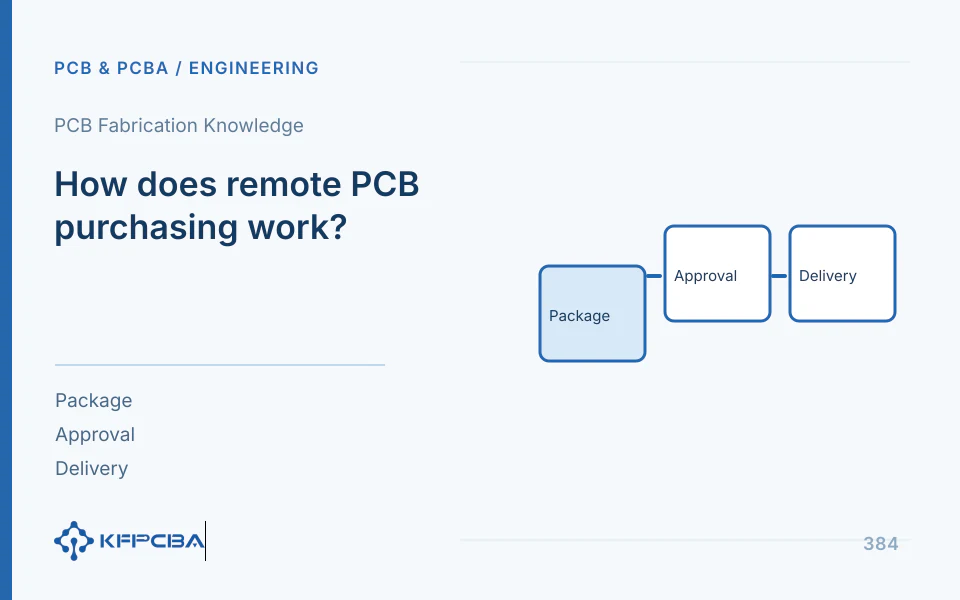
Remote procurement connects four chains
Remote PCB purchasing requires joint management of documentation, engineering, delivery, and Acceptance. Customers in Dongguan, Guangzhou, and other regions can use the same remote-confirmation method. The receiving city does not change PCB process definitions or establish that the supplier has a local factory. This article provides purchasing-coordination checklists; specific order acceptance and shipping arrangements require separate confirmation.
| stage | Customer to Provide | manufacturer/delivery party responsible for response |
|---|---|---|
| Document Transfer | Controlled file package, versions, and revision records | Receipt list, missing items, and referenced version |
| Engineering Confirmation | Permitted changes, approval contacts, and timing requirements | Issues, impact, and pending approval proposals |
| Shipment Transport | Receiving address, contact, and split-delivery acceptance conditions | Packaging, shipment node, and transport arrangement |
| Receiving Inspection | Agreed inspections, exception notifications, and quarantine methods | Board identification, accompanying documentation, and exception-handling contacts |
Avoid multiple “final versions” in chat attachments
Number complete packages and record filenames, revisions, and checksums. When changing files, state whether the whole package or one controlled file is replaced. Return manufacturing-confirmation drawings and issue lists to project records; production follows approval. Both parties must authorize channels for confidential designs; public online viewers are not mandatory entry points.
Arrival time and exception handling agreed separately
Expected Arrival Date Work backward to schedule engineering confirmation, manufacturing, and shipping. After receipt, retain packaging and labels and inspect against approved documentation. For abnormalities, provide board IDs, locations, photos, methods, and readings. Both parties should check revisions and measurements before deciding on return shipping, retesting, or other disposition. A chat message saying “there is a problem” cannot replace traceable records.
- Designate one engineering-approval contact and one purchasing/receiving contact.
- Send complete, consistent-revision documentation and close omissions and engineering issues.
- Confirm quantities, release documentation, and shipping arrangements in writing.
- Inspect upon receipt, quarantine abnormalities, and retain evidence and closure results.
Document Requirements See PCB Manufacturing Document List. Structural Selection See PCB Catalog. Quality Responsibility See Quality and acceptance requirements. Via Quotation Entry State the receiving region, revision, and project stage. For on-site discussions, first use Contact Entry Verify Arrangement.
Data Basis:Engineering reference | Gerber manufacturing data: layer functions, drilling, and attributes, checked on 2026-10-05. Used for the corresponding file, structure, or material descriptions in this article. The procurement checklist is a communication method, not a statement of universal fabrication capability or delivery commitments.
Related procurement and acceptance Q&A
How can remote teams avoid manufacturing the wrong files when multiple final versions are sent?
Number complete packages and record directories, revisions, and checksums. State whether the whole package or one controlled file is replaced. Return manufacturing-confirmation drawings and issue lists to approval records.
See: Avoid multiple “final versions” in chat attachments
Which confirmation roles do remote customers need?
Clearly separate engineering approval from purchasing/receiving, assigning issue closure and quantity/delivery responsibilities respectively. Designated contacts control files and acceptance; forwarding across multiple chat groups does not create approval.
See: Connect four processes in remote purchasing
Is sending photos sufficient for remote anomalies?
Provide board IDs, locations, revisions, methods, and readings; retain labels/packaging and quarantine abnormalities. Both parties should check measurements and revisions before deciding on return shipping or retesting.
See: Agree separately on arrival timing and exception handling
How should I work backward from the expected arrival date?
Schedule engineering confirmation, manufacturing, shipping, and receipt/acceptance separately. Define split-delivery acceptance, packaging, and release documentation in writing rather than using one date for every task.
See: Agree separately on arrival timing and exception handling
Do Dongguan or Guangzhou customers need different acceptance and documentation requirements?
Receiving regions do not change technical definitions. Use identical controlled files and acceptance methods, then separately confirm addresses, shipping, and on-site or remote arrangements.
Answer delivery method first: who delivers to whom
Confirm whether the supplier arranges shipping, the customer nominates a carrier, or the customer collects. Then agree on dispatch location, receiving address, receiving hours, contacts, split deliveries, and accompanying documents. Supplier dispatch, carrier collection, customer receipt, and technical acceptance are separate milestones; logistics receipt cannot replace acceptance of conforming boards.
| Delivery Field | Requires Mutual Confirmation | What to Leave |
|---|---|---|
| Shipping Method | Carrier arrangement, fees, and service scope | Written response and shipping manifest |
| Packaging | Board protection, identification, documentation, and special requirements | Packing List and Shipping Photos |
| Batching | Quantity per batch, version, date, and report | Batch List and Cumulative Quantity |
| Handover | Receiving windows, exception notifications, and responsible contacts | Sign-off and Exception Records |
| Technical Acceptance | inspect per approved drawing and agreed checklist | Incoming Results and Closure Status |
City names such as Shenzhen, Dongguan, and Guangzhou only provide destination context. Actual shipping requires specific addresses, time windows, and carrier conditions; they do not establish universal same-day delivery or fixed charges. Confirm locations and appointments separately for collection or on-site discussions; meeting locations may not handle dispatch.
Counting by batch and freight charges calculated separately
Suppose an order contains 120 boards, with 80 delivered first and 40 later. Record accepted quantities, revisions, and packaging for each delivery. If 2 boards in the first delivery are quarantined pending disposition, the currently usable count is 78, not 80. Record subsequent replacement and disposition separately. Cumulative shipped quantities alone cannot establish complete delivery of accepted boards.
Shipping charges may use actual or volumetric weight according to the carrier's quotation. Suppose three cartons each weigh 8 kg and measure 40×30×20 cm. Using a volumetric divisor of 6000 cm³/kg only as an example gives 4 kg volumetric weight per carton; the higher value is 8 kg, for a total chargeable weight of 24 kg. Divisors and rounding are not universal standards. Recalculate under the current carrier's rules; this example does not establish shipping charges.
Remote approvals should confirm receipt of the same package
Send directories, revisions, and checksums; recipients should acknowledge the same package ID. Drawing or issue-list changes should state replacement scope. Receipt does not equal manufacturing approval: engineering approval must also define adjustments, materials, and inspections. Designate a master record when multiple people forward files, avoiding separate final attachments in different groups.
Use mutually authorized methods for remote previews if needed, but graphical previews cannot replace complete manufacturing files, drills, and stackups. Record file completion, issue closure, and actual production start separately, updating delivery schedules with approval status. Transfer confidential projects within mutually authorized scope; public viewers are not mandatory steps.
Record packaging and technical abnormalities separately
For damaged cartons, moisture, or quantity discrepancies, retain packaging, labels, shipping documents, and photos first. For hole-position, dimensional, or electrical concerns, separately provide board IDs, locations, revisions, methods, and measurements. Both issue types may coexist; preserve links without assuming causation. Quarantine suspect boards after receipt rather than mixing them with normal boards.
For remote retesting, align samples, datums, and tools before deciding on sample shipments or returns. Preserve original condition before disposition, inspect affected items after rework, and archive initial and repeat inspections separately. Final outputs should include usable quantities, pending quantities, missing documents, and closure evidence so purchasing and assembly can plan subsequent tasks.
Bring receiving and engineering information together at delivery
Packing lists should include package IDs, board IDs or batches, revisions, quantities, and accompanying files so recipients can check each item. Electronically delivered engineering reports should reference the same batch IDs, preventing arrivals without identifiable evidence. Update lists after shipping-method changes or split shipments; do not retain the original single-carton quantity description.
Source material and applicable scope
- Ucamco, “Gerber Format — Official Gerber Format Website”; version: online page, no fixed revision identified; checked 2026-10-18; relevant sections: Gerber layer files, attributes, and Job file responsibilities. Supports only definitions of manufacturing files and revision objects. This page's batch, visit, and logistics checklists are this site's purchasing-coordination methods, not original-vendor services or company commitments.