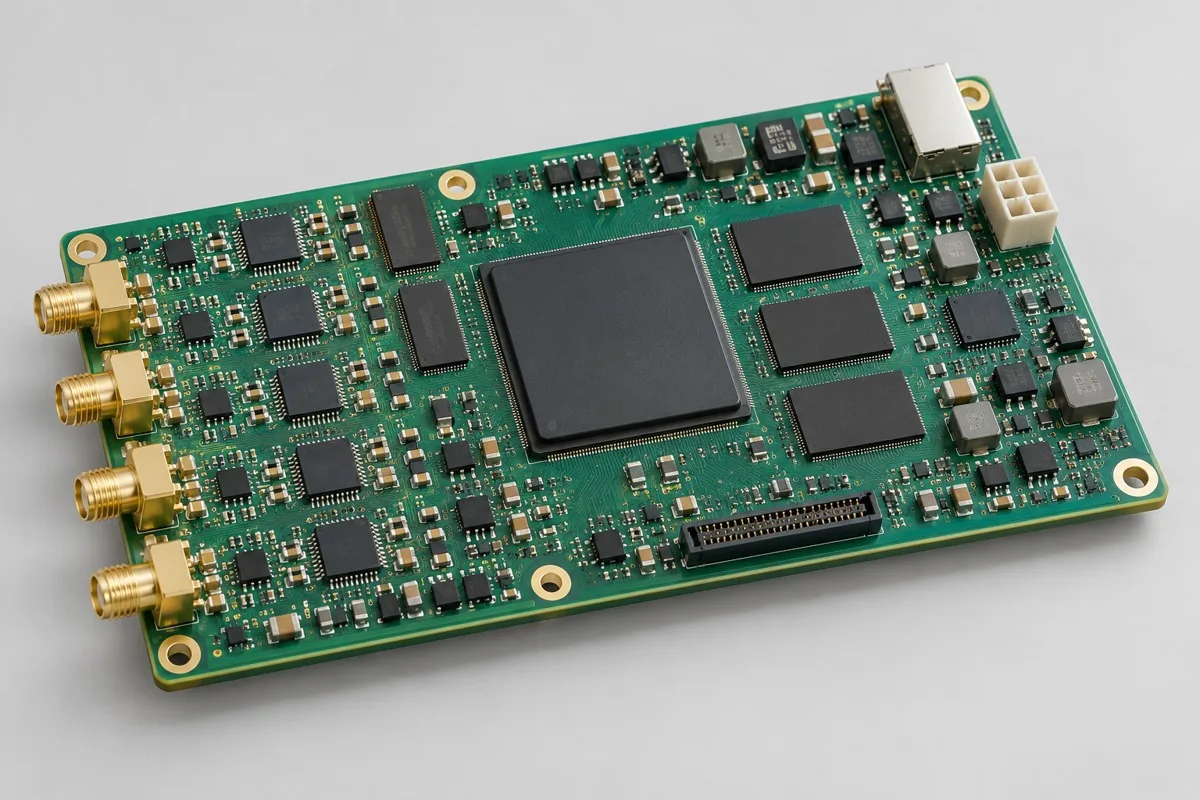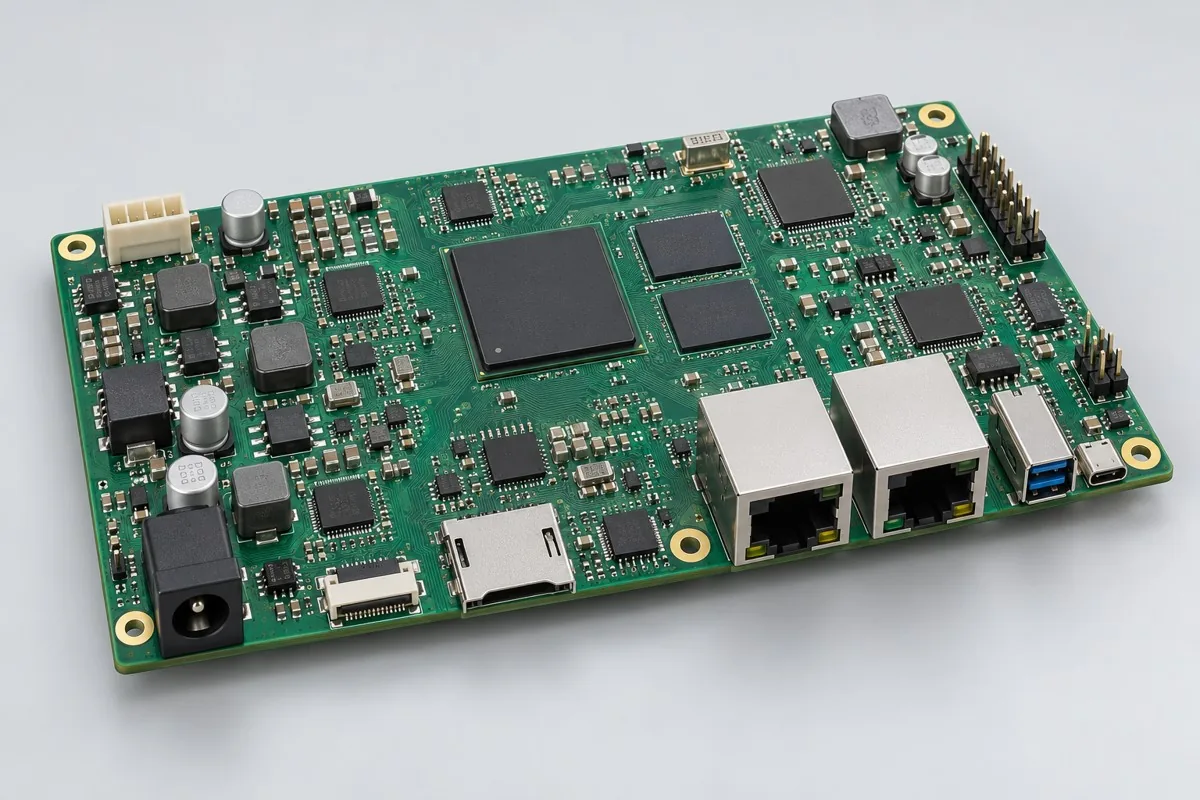
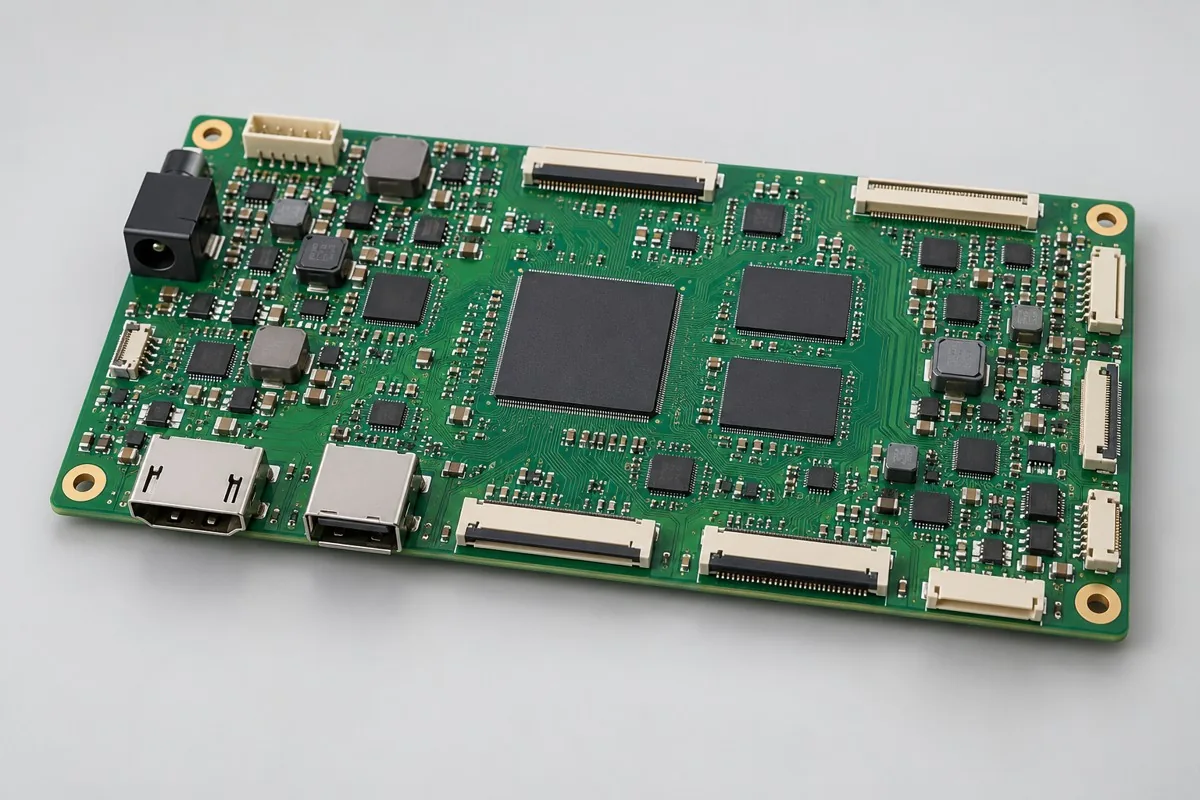
Engineering Reference Configuration
Industrial display PCB assembly: configuration, testing, and deliverables
The following adjustable engineering configurations support material, functional, and process review; they are not stocked models or commitments to current production-line capabilities. Approved fabrication documentation and order acceptance requirements govern.
Industrial display mainboard PCB assembly supports contract manufacturing/procurement review for image display, touch input, and backlight control. Confirm BGA display processor + DDR + storage, LVDS/MIPI options, USB/I2C touch, maintenance serial port, and baseline 6-layer FR-4 with continuous display-interface reference planes. Compare SMT → hidden-joint validation → software → display/harness integration and acceptance costs for color bars, touch grids, backlight, sleep/wakeup, and interfaces. Distinguish display mainboard + adaptation revision + test-image records from board-only or display/harness/bracket assemblies so quotations match actual use. RFQ reference:BOM · bare board · material supply
Reference specification and configuration options
| Options | Reference Configuration |
|---|---|
| Power and Logic Domains | 12V input; separate backlight supply branch |
| Functional Module | Industrial image display, touch input, backlight control |
| Core Components/Architecture | BGA display processor + DDR + storage |
| Interface and Channels | LVDS/MIPI display options; USB/I2C touch; maintenance serial |
| Board Layers and Material Options | Baseline 6-layer FR-4; continuous display-interface references |
| Component types | BGA, FPC connectors, DC/DC, backlight sockets |
| Assembly Route | SMT → hidden-joint validation → software → display/harness integration |
| Material Supply Scope | Specified display/touchscreen models; mainboard materials by BOM |
| Firmware and Parameters | Separate display-parameter, touch-orientation, backlight-curve, and application revisions |
| Test Focus | Color bars, touch grids, backlight, sleep/wakeup, interfaces |
| Deliverables | Display mainboard + display-adaptation revision + test-image records |
| Configuration Limits/Options | Board-only or display/harness/bracket assemblies |
How much does industrial display mainboard PCB assembly cost, and what does the quotation include?
BGA processors, DDR, display connections, and backlight branches affect costs. Itemize hidden-joint inspection, display-parameter programming, color bars, touch grids, and sleep/wakeup; list display/bracket/harness assemblies separately. Display size alone cannot price mainboards.
Quotation terms depend on the approved files, quantity, material supply, tests and delivery requirements.
Prepare a structured RFQ or use the short inquiry form.
| Cost Item | Scope for This Configuration | Billing frequency and work scope | Procurement Verification |
|---|---|---|---|
| Bare PCB and core components | BGA display processor + DDR + storage; baseline 6-layer FR-4; continuous display-interface reference planes | Price according to actual bare-board/component purchase quantities; authorize critical components and substitutions individually | Specified display/touchscreen models; mainboard materials by BOM |
| Placement and Post-Assembly | SMT → hidden-joint validation → software → display/harness integration | Feeder/program setup per lot; assembly priced per board, joint, or process as agreed, with counting rules specified | BGA, FPC connectors, DC/DC, backlight sockets |
| Manufacturing Preparation | Review stencils, first articles, and support tooling against the actual assembly route | New stencils/carriers may be separate one-time charges; verify panelization, revision, and condition before reuse | Reduced quantities do not automatically eliminate first-article or feeder setup |
| Functional Support | Color bars, touch grids, backlight, sleep/wakeup, interfaces | Itemize test-method/fixture/script setup; agree execution charges per board, channel, or test duration | Separate supporting development from execution records for each board |
| Software and Parameters | Separate display-parameter, touch-orientation, backlight-curve, and application revisions | When firmware exists, distinguish file programming/verification from software development; omit programming without a firmware revision | Customer-approved files, parameters, and readback rules determine scope |
| Delivery and Change | Display mainboard + adaptation revision + test-image records; board-only or display/harness/bracket delivery | Price accessories, retesting, and revision changes by approved work items; do not prefill fixed rates | Check BOM, tooling, programs, and acceptance revisions before reorders |
How should industrial display mainboards and display bridge boards be selected?
Mainboards process, store, and run applications; bridge boards connect existing systems to displays. Define independent HMI processing needs before comparing components, software, and adaptation costs. Shared LVDS interfaces do not make products equivalent.
| Comparison Metric | Current Conditions | Factors Influencing Procurement Decision |
|---|---|---|
| Manufacturing Delivery | SMT → hidden-joint validation → software → display/harness integration | Produce boards/assemblies per BOM and assembly drawings; this does not establish that every system function passes |
| Functional Acceptance | Color bars, touch grids, backlight, sleep/wakeup, interfaces | Compare unit prices after defining test stimuli, limits, accessories, and records; review missing test inputs first |
| Configuration Options | LVDS/MIPI options; USB/I2C touch; maintenance serial; baseline 6-layer FR-4; continuous display-interface reference planes | Confirm circuit/program compatibility before reviewing assembly and test costs for interface, stackup, or component changes |
| Delivery Scope | Board-only or display/harness/bracket assemblies | Complete-system accessories, application development, and project verification are not automatically included in board assembly |
How should LVDS or MIPI industrial displays be selected?
Select by specified displays, levels, connectors, and processor support, matching parameters/routing. Size alone does not establish interchangeability; check touch orientation, backlight power, and wake behavior.
- First list industrial display, touch, and backlight functions, distinguishing build-to-print manufacturing, configuration changes, and new development.
- Freeze complete BGA processor/DDR/storage parts, LVDS/MIPI, USB/I2C touch, serial maintenance, and baseline 6-layer FR-4 with continuous reference planes. Separate consigned/sourced materials using specified display/touch models and mainboard BOM procurement.
- First articles check SMT → hidden-joint validation → software → display/harness integration and separate display/touch/backlight/application revisions. Agree on verification for customer program files; review development separately.
- Turn color bars, touch grids, backlight, sleep/wakeup, and interfaces into acceptance items with stimuli, limits, records, fixture ownership, per-board execution, and post-rework retests.
- Confirm display mainboard + adaptation revision + test-image records and board-only versus display/harness/bracket delivery. Compare equal quantities, accessories, and test scope, then freeze orders.
Applicable uses and situations requiring separate review
This industrial HMI mainboard includes display processing, DDR, images, touch, and backlight. Automotive center-console interface boards typically bridge existing controls to specified displays and handle vehicle events. Shared LVDS/MIPI does not establish matching processing, power, environment, or qualification. Segment displays do not need this architecture; validate adaptation before display changes.
Simple digit/segment displays do not need BGA processors. Projects with frequent display changes should validate adaptation before freezing complete-product production materials.
Assembly Challenges for This Product
FPC latches depend on reflow tolerance/assembly handling; illustrate latch direction, insertion depth, and copper orientation. Inspect processor joints, connector terminations, and backlight power devices separately; release regions hidden after display installation before enclosure assembly.
Structural, thermal, and configuration trade-offs
Separate backlight drivers isolate heat but add harnesses/connectors; integrated boards are compact but require display-heating validation. LVDS/MIPI changes can alter routing/firmware, not sockets alone.
Product-specific test matrix
| Test stage | Inspection/Functional Methods | Acceptance Record |
|---|---|---|
| Image chain | Run color bars, solid colors, and moving images on approved displays | Display model, image anomalies, interface configuration |
| Touch chain | Grid touches and edge swipes; check rotation | Coordinates and response logging |
| Powering/Status | Adjust backlight and test sleep/wakeup, recording current/unexpected resets | Backlight levels and status switch results |
Defect Handling and Acceptance
Do not attribute every image fault to BGA soldering; distinguish parameters, cable contact, and power noise. Check touch orientation/calibration first for offsets. Acceptance applies to specified display/harness combinations, not every compatible display.
Industrial HMI display PCB assembly: supply and revision control
Display/touch-module changes need hardware revisions and driver-change notes; trace fragile FPC cables by batch. For customer displays, define damage assessment, spares, and test-display ownership.
Prototype and production planning
Prototype adapter cables are acceptable for validation; production uses fixed-length harnesses/controlled insertion sequences. Fixtures assess display, touch, and backlight separately rather than one visual “normal” judgment.
Delivery Configuration
Display mainboard + adaptation revision + test-image records. Board-only or display/harness/bracket assemblies.
Convert this configuration into a reviewable order
For BGA industrial display mainboards, check BOM, quantity, supply, and conditions below; add pick-and-place files/CPL, DNP, and assembly drawings for SMT. Provide files, programming rules, and checksums for separate display/touch/backlight/application revisions. Price materials, SMT → hidden-joint validation → software → display/harness integration, stencils/setup, carriers, and test equipment separately. Reapprove file changes; agree delivery after kit/schedule confirmation.
| Required project inputs | Engineering Decisions Affected | Records/delivery as agreed in the order |
|---|---|---|
| Display and Touch Combination | Provide display model, ribbon orientation, resolution, touch protocol, and backlight loads to determine parameters/test equipment. | Retain display, touch-coordinate, and backlight records for specified combinations. |
| Assembly Fixing | Provide interface latches, cooling, enclosure height limits; define later-installation sequence. | Link first-article photos/height checks to assembly revisions; reconfirm compatibility after display changes. |
Industrial display mainboard PCB assembly FAQ
How much does industrial display mainboard PCB assembly cost, and what does the quotation include?
Itemize BGA inspection, display adaptation, touch and backlight checks. Confirm the files, quantities, material responsibilities, test records, delivery destination, currency, taxes, shipping, and trade terms before comparing totals. Review the quotation scope.
Does display-mainboard pricing include touchscreens?
Separate materials/integration for boards and display/harness/bracket assemblies. Define touch software, display parameters, and backlight revisions so board prices are not mistaken for complete HMI costs.
Does a same-size display need readaptation?
Size does not establish matching interfaces, timing, pins, or backlight. Recheck complete models and run color bars, touch, and sleep recovery rather than merely checking an image appears.
Why can separate display-mainboard backlight boards cost more?
They add daughterboards, connections, and assembly but improve heat placement. Integrated boards need display-heating checks. Compare total mechanical costs with identical displays/brightness.
Must production industrial HMI mainboards retain display parameters?
Maintain display parameters, touch direction, backlight curves, and application revisions separately, linking image results to display models. Later display/firmware changes can then be assessed for readaptation.
How should image-path testing enter industrial display mainboard acceptance?
The reference method runs approved-display color bars, solid colors, and moving images; records include models, anomalies, and interfaces. Provide inputs, configurations, and limits before agreeing first-article/per-board scope; price preparation separately from execution. Without limits, review methods rather than claiming specification compliance from completed operations.
How should touch-path testing enter industrial display mainboard acceptance?
The reference method uses grid touches/edge swipes and rotation checks; records include coordinates/responses. Provide inputs, configurations, and limits before agreeing first-article/per-board scope; price preparation separately from execution. Without limits, review methods rather than claiming specification compliance from completed operations.
How should power/state testing enter industrial display mainboard acceptance?
The reference method adjusts backlight and tests sleep/wakeup, recording current/resets and backlight settings/state transitions. Provide inputs, configurations, and limits before agreeing first-article/per-board scope; price preparation separately from execution. Without limits, review methods rather than claiming specification compliance from completed operations.
With customer software, how should industrial display mainboard programming and development be priced separately?
Controlled content has separate display/touch/backlight/application revisions. Programming approved files, loading parameters, and readback are manufacturing execution; new logic, adaptation, and algorithms require development review. List preparation, per-board programming, verification, and failures separately; programming inclusion does not imply application development.
Is BGA hidden-joint inspection priced per component or board for industrial display mainboards?
Packages include BGA, FPC connectors, DC/DC, and backlight sockets. List actual BGA parts, quantity, and inspection scope, then agree per-component/board/labor charges, methods, ratios, images, and post-rework checks. Independently confirm color bars, touch, backlight, sleep/wakeup, and interfaces. Set inspection dimensions, ratios, and equipment from actual packages, not BGA labels.
How should industrial display mainboard totals compare consigned critical parts and sourced remaining parts?
Create responsibilities using specified display/touch models and BOM-based board sourcing. Confirm full parts, quantity, packaging, and leftovers. Consignment only changes procurement boundaries; SMT, hidden-joint validation, software, integration, and color-bar/touch/backlight/sleep/interface checks remain work. Approve shortages/substitutions/batch impacts first; consigned unit prices are not material-inclusive totals.
What needs retesting after industrial display mainboard repair or supplemental orders?
Use change impact. Original items are color bars, touch, backlight, sleep/wakeup, and interfaces; records are mainboard + display revision + test images. Power/interface/analog/software changes need related tests, not joints alone. Align supplemental BOM, parameters, and equipment; charge by approved items/actual quantities without assumed free service or fixed turnaround.
Compare Other Products in This Category
- Automotive central control display interface board: automotive bridging, power events, display/harness combinations; qualify separately.
- BGA communication gateway motherboard: Network processors, memory, and interface connectivity.
Return to BGA PCB assembly configuration comparison · Component Supply and Procurement · Testing and Delivery Scope
Material and Process Reference
- Engineering reference | BGA assembly methods: pad definitions, warpage, and hidden solder joints: methods for BGA pads, temperature profiling, and hidden solder joint inspection. Use current manufacturer documents for each component; do not transfer example limits
- Engineering reference | Moisture-sensitive component management: MSL, floor life, and reflow conditions: a basis for moisture-sensitive component management methods only; not evidence of KFPCBA equipment, qualifications, or order scope