Engineering reference design · prototype validation pending
Pet feeder design: from RTC schedules to mechanical portion counting
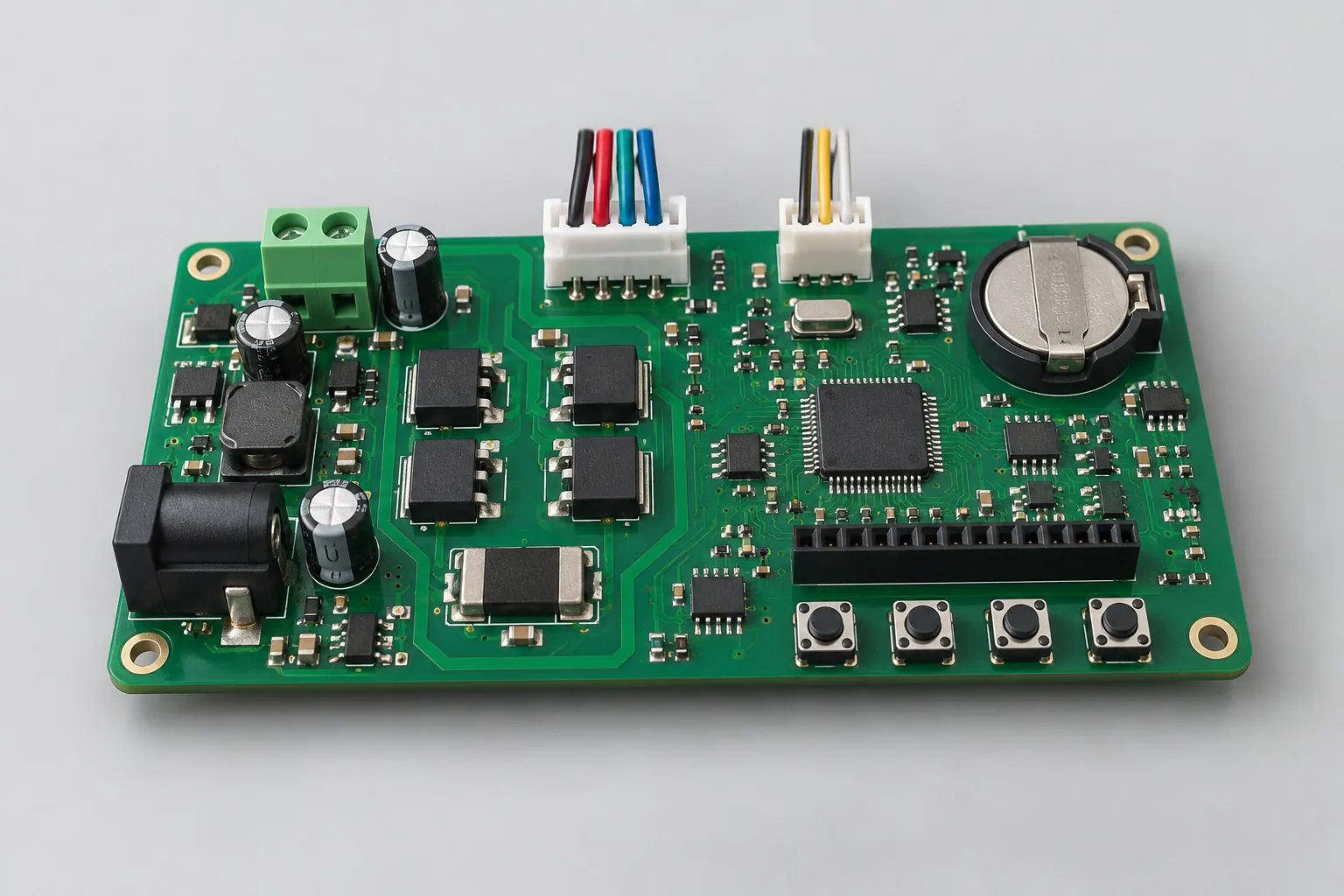
Pet feeder control board design uses RTC schedules, dispensing feedback, and motor drivers for offline feeding, with jam detection and limited retries. Validate portions using the actual dispensing mechanism and food granules. Power-loss records and task deduplication prevent repeated feeding.
Custom development reference design. The following parameters are requirement configurations and design targets; validate functions and performance through agreed prototype tests.
| Functional Partition | Design and Inspection Objects |
|---|---|
| Clock / Settings / Encoder | Define RTC, button settings, and Hall/optical feedback inputs separately. Measure the mechanism's sensor timing for one portion. |
| Timer and power-off status | The controller manages task IDs, portion counts, and completion records. Freeze rules for continuing/abandoning interrupted feeding first. |
| H-Bridge Motor Driver | For DC/stepper designs, select the appropriate DRV8833-class H-bridge and drive method, checking startup and stall current. |
| Dispensing Mechanism | Define what the selected feedback sensors can detect during rotation, an empty hopper, and jams; these conditions may require different sensing methods. Validate portions by actual weighing. |
| Power / Backup Clock | Budget the 5V adapter and RTC backup domain separately. Motor starts/stops should not reset the controller or lose time. |
| Stall / Safe Shutdown | Stall reversal requires retry-count and thermal limits. Stop and alarm at the limit, and prevent duplicate task execution after recovery. |
How much does pet feeder control board design cost, and how is the quotation calculated?
Discuss feeder board quotations together with the dispensing mechanism. Time-based motor operation and feedback-based portion counting require different sensing and firmware. Stall retries, RTC schedules, and task deduplication also affect testing. Itemize hardware, local firmware, actual food validation, and prototype boards separately. Network applications and cloud services are not default inclusions in local feeding development.
Quotation terms depend on the approved files, quantity, material supply, tests and delivery requirements.
Prepare a structured RFQ or use the short inquiry form.
| Quotation Items | What services are included | What to Check When Comparing Quotes |
|---|---|---|
| Circuit and PCB Design | RTC schedules, motor drivers, and mechanism feedback | Reusable portions of existing designs and circuit/mechanical changes |
| Software and Validation | Stall, portion counting, and task deduplication | Motor/feedback debugging differs from actual food portion testing |
| Prototype Preparation | Bare PCB, BOM procurement, assembly, and agreed prototype quantity | Whether material/component revisions, prototype quantities, and test targets match |
| Subsequent Revision | Record new requirements separately from post-test corrections | How agreed changes, source files, and validation results are delivered |
Should a feeder count portions by motor run time or mechanism feedback?
Timed drive is simple, but portions depend on food granules, battery level, and the mechanism. Feedback-based portion counting adds sensing and state handling. Select based on permissible error and jam behavior. Action counts do not directly equal weight.
Should networking be added to a feeder control board?
Local schedules reduce network dependence. Remote commands add network setup, applications, and duplicate-task handling. First define continued offline operation, task handling after reconnection, and responsibility for the local clock.
Does a feeder development quotation include calibration of each portion's weight?
Motor/feedback debugging differs from actual food portion testing. Quotations should list the mechanism, granule types, remaining-food conditions, and weight records. List apps or cloud services separately; they are not automatically part of the local control board.
Reference configuration from RTC schedules to mechanical portion counting
| Configuration Field | Reference Configurations/Selections | Basis and Status |
|---|---|---|
| R&D Direction | Timed pet feeding R&D reference configuration | Illustrative design direction; requirements and prototype validation must be agreed |
| Reference Function | Scheduled feeding, manual feeding, and stall alarms | Design Objective |
| Power Supply Objective | 5V adapter; backup battery as a separate extension | Design Objective |
| Actuator | 1 Speed-Reduced DC Motor or Stepper Motor | Design Objective |
| Driver Candidate | DRV8833-class H-bridge selected for motor rated/stall current | Design Objective |
| Sensor Interface | 1 dispensing Hall/optical input + 1 food-level input | Design Objective |
| User Interface | Optional buttons, buzzer, LED, or small display | Design Objective |
| Time Retention | RTC plus backup power candidate | Design Objective |
| Stackup plan | 2-layer FR-4 with separate control/motor zones | Design Objective |
| Firmware Strategy | Schedules, portion counts, limited retries, and power-loss records | Design Objective |
| Mechanical Input | Sensor timing for one portion of gear/dispensing-disc rotation | Design Objective |
| Verify Output | Portion repeatability, motor stall, and power-fault records | Design Objective |
Grain Weight and Retry Limit
Assess whether the selected feedback and load-sensing method can detect unloaded operation; rotation counts alone do not establish food delivery. Feeding for a fixed motor duration is simpler but varies with battery charge and food-particle characteristics.
Stalls may trigger reverse retries, but retry counts must be limited and alarms provided. Unlimited retries can cause heat buildup.
Design RTC time retention and power-loss task deduplication together to prevent duplicate feeding after power restoration.
Design budget and trade-off examples
Check design targets with engineering calculations
Assuming motor running current of 0.4A and stall current of 1.2A, the power supply and driver must be checked for fault conditions at three times running current. Current-threshold stall detection must also distinguish startup transients.
Conditions and Scope of Application:Determine thresholds, durations, and stopping actions through actual motor and mechanical tests. Cumulative dispensed quantity cannot be promised solely from motor run time in seconds.
Replace examples with selected components and record margins; calculations support design choices, while prototype records support acceptance.
Power and board layout from RTC schedules to mechanical portion counting
- Place motor power and high-current ground near the inlet. Organize logic-domain decoupling and sensor return paths independently.
- Keep H-bridge thermal pads and protection nearby. Provide error-proofing and strain relief for motor connectors.
- Keep the RTC crystal and sensing signals away from motor switching copper, and provide a separate current measurement point.
Feeder control board R&D input
- Motor stall current, mechanism timing, and target portion
- Different food granule sizes, feeding schedules, and retry rules
- Power/backup requirements, enclosure, and cleaning method
If circuit files exist, provide editable schematics, PCB, BOM, and current issues, and agree on review or revision scope. If only functions are defined, freeze this page's inputs before selection and circuit development. Agree separately on control-software and external-application responsibilities, interfaces, and acceptance.
Feeder control board phase delivery
| phase | Engineering Work for This Proposal | Reviewable Deliverables |
|---|---|---|
| Requirements and Design Freeze | Freeze motor/mechanism timing, food granules/portions, schedules, retries, and backup requirements | Functional/interface requirements, mechanical revision, acceptance conditions, and open items |
| Schematic and Component Selection | Design the RTC, feedback inputs, H-bridge, user interfaces, and task storage for power loss | Editable schematics, controlled BOM, footprint checks, and design calculations for these circuits |
| Layout and Routing | Separate high motor current from sensor/clock return paths, and implement error-proof terminals and thermal pads | PCB source files, actual stackup/hole/net constraints, DRC, and assembly-dimension checks |
| Simulation/Calculation | Budget startup/stall conditions, driver heating, and time retention, and define portion statistics and deduplication rules | Design calculations/models, input conditions, margins, and items awaiting measurement |
| Prototype and Software | Build a feeding control prototype and integrate schedules, feedback-based portion counting, limited retries, and power-loss records | Manufacturing package, feeding prototype, agreed schedule/portion-counting firmware, mechanism parameters, state/task records, and recovery instructions |
| Testing and Version Closure | Measure portions from the actual mechanism and test jam/empty-hopper conditions and power-loss recovery at every task stage | Procedures, wiring, raw results, and decisions for the prototype revision; include issue/change and limitation lists |
Portion, stall, and task-recovery verification
- Portion statistics across food granules, power conditions, and remaining food levels
- Manual jam timeout, retry count, and alarm
- Recovery and Task Deduplication After Feed Power Interruption
- Motor/H-bridge temperature rise during continuous feeding and button faults
Measure portions from the actual mechanism and test jam/empty-hopper conditions and power-loss recovery at every task stage. Document test equipment, operating conditions, versions, and criteria in the report, with passed and untested items.
Portion, stall, and task deduplication validation worksheet
The table below breaks RTC schedules through mechanical portion counting into executable checks. Freeze samples, equipment, environment, and permissible deviations before testing. Associate results with this revision's raw records.
| Verification Object | Pre-Production Freeze | How to Test Prototypes in Practice | Delivery and Acceptance Records |
|---|---|---|---|
| Portion Definition | Food granule specifications, dispensing mechanism, target mass per portion, and tolerance | Repeat feeding at different voltages and food levels, recording each portion's mass by weighing | Deliver counts, mean values, and distributions; motor run time does not directly equal portion size |
| Stall and Retry | Motor stall current, feedback type, and maximum retry count | Simulate food jams/empty hopper and observe drive, reversal, and alarms | Retain current and state timelines; enter the agreed stopped state at the retry limit |
| Task Deduplication | RTC time setting, task IDs, and power-loss recovery rules | Interrupt and restore power at feeding start, midway, and during completion-record writing | Check task and dispensing records, and define recovery strategies for partially completed tasks |
Manufacturing and assembly coordination for this design
- Freeze motor harnesses, sensor mounting positions, and mechanical tolerances together.
- Fixtures use actual feedback timing and stall simulation. Include firmware versions and portion parameters in records.
Link design revisions to schematics, BOM, PCB, fabrication, and software documentation. When fabricators adjust stackup, materials, or holes, or Assembly parties propose substitutions, recheck critical electrical and test conditions together.
Common questions on purchasing and customization
How much does pet feeder control board design cost, and how is the quotation calculated?
A project-specific quotation requires review of the available files, quantity, materials, requested tests, delivery destination, taxes, shipping, and trade terms. Complete development separately prices circuits, firmware, prototypes, and verification. Any formula on this page organizes cost inputs; it is not a quoted rate.View cost items, calculation conditions, and sources.
Should a feeder count portions by motor run time or mechanism feedback?
Timed drive is simple, but portions depend on food granules, battery level, and the mechanism. Feedback-based portion counting adds sensing and state handling. Select based on permissible error and jam behavior. Action counts do not directly equal weight.
Should networking be added to a feeder control board?
Local schedules reduce network dependence. Remote commands add network setup, applications, and duplicate-task handling. First define continued offline operation, task handling after reconnection, and responsibility for the local clock.
Does a feeder development quotation include calibration of each portion's weight?
Motor/feedback debugging differs from actual food portion testing. Quotations should list the mechanism, granule types, remaining-food conditions, and weight records. List apps or cloud services separately; they are not automatically part of the local control board.
Will a feeder repeat a task after power loss?
Define task IDs, RTC behavior, and record recovery logic. Include checks of feeding counts under power loss and repeated commands in prototype testing.
How should feeder portion delivery be verified?
Collect dispensing statistics with actual food granules, food levels, and battery levels, and check jams and retries. Parameter changes cannot rely solely on the original calibration.
How should a feeder budget separate the mechanism and control package?
First freeze the motor, feedback, hopper, and food granules. The base package covers RTC schedules, drivers, and task deduplication, while mechanism portion counting/weight measurement is an actual prototype task. List networking, apps, and remote maintenance separately. Firmware development on the same board and debugging different dispensing mechanisms cannot be compared by motor count alone.
What driver information is required for layout-only feeder work?
Provide motor startup/stall data, feedback signals, RTC retention, power, and board outline, and confirm driver protection and mechanism connectors. Layout implements power and return paths; portion counting, jam retries, and task recovery after power loss still require firmware. Completing the PCB does not complete the function when the dispensing mechanism is undefined.
Is task deduplication development still required with an existing networking module?
Local schedules and remote commands require unified task IDs and completion records, with defined handling after power loss, timeouts, and reconnection. Existing network setup can be reused, but duplicate-feeding risk requires actual power-loss and repeated-command regression tests. An app sending commands does not establish completed board-side task logic.
Which mechanism parameters should feeder source code include?
Deliver source files for driver circuits, feedback connections, RTC, and power. Firmware includes schedules, portion counting, stall thresholds, retries, and task record formats. Retain weight statistics by food granules, food levels, battery levels, and mechanism revisions in the report so the applicability of original parameters is clear after food or mechanism changes.
How to Requote When Adding Weight Sensors?
Add sensors, mounting load considerations, analog/digital front ends, and calibration, then modify portion-counting algorithms and fault handling. Existing motor drivers and schedules may remain, but actual weighing and remaining-food conditions require new tests. Sensor purchasing prices or one extra interface do not represent the full development cost of weight control.
Can a feeder board directly reuse different dispensing motors?
First check voltage, stall current, drive method, and feedback to assess circuit, protection, and mechanical timing compatibility. Schedule and task ID logic may be reused, but repeat food weight statistics and jam regression testing. Matching terminals do not establish direct motor interchangeability.
How should RFQ documentation be prepared before commissioning pet feeder control board design?
For initial discussions, describe target functions, intended use, and existing files. Engineering quotations further confirm motor stall current, mechanism timing, and target portion; different food granule sizes, feeding schedules, and retry rules; power/backup requirements, enclosure, and cleaning method. For existing circuits, provide editable schematics, PCB files, and BOMs. For faulty prototypes, include versions and reproduction records. List documentation gaps as review tasks first so both parties quote using the same assumptions.
How should prototype validation costs for pet feeder control board design be compared by operating condition?
Before comparing, fix prototype quantities, versions, test equipment, and criteria sources. For this design, check at least these areas separately. Portion definition: freeze food granule specifications, dispensing mechanism, target mass per portion, and tolerance, then repeat feeding at different voltages and food levels and record each portion's mass by weighing. Stalls and retries: freeze motor stall current, feedback type, and maximum retry count, then simulate jams/empty hopper and observe drive, reversal, and alarms. Task deduplication: freeze RTC time setting, task IDs, and power-loss recovery rules, then interrupt and restore power at feeding start, midway, and during completion-record writing. State whether raw data and issue closure are delivered in the quotation. One successful power-up does not constitute full validation.
Compare related designs and plan the next step
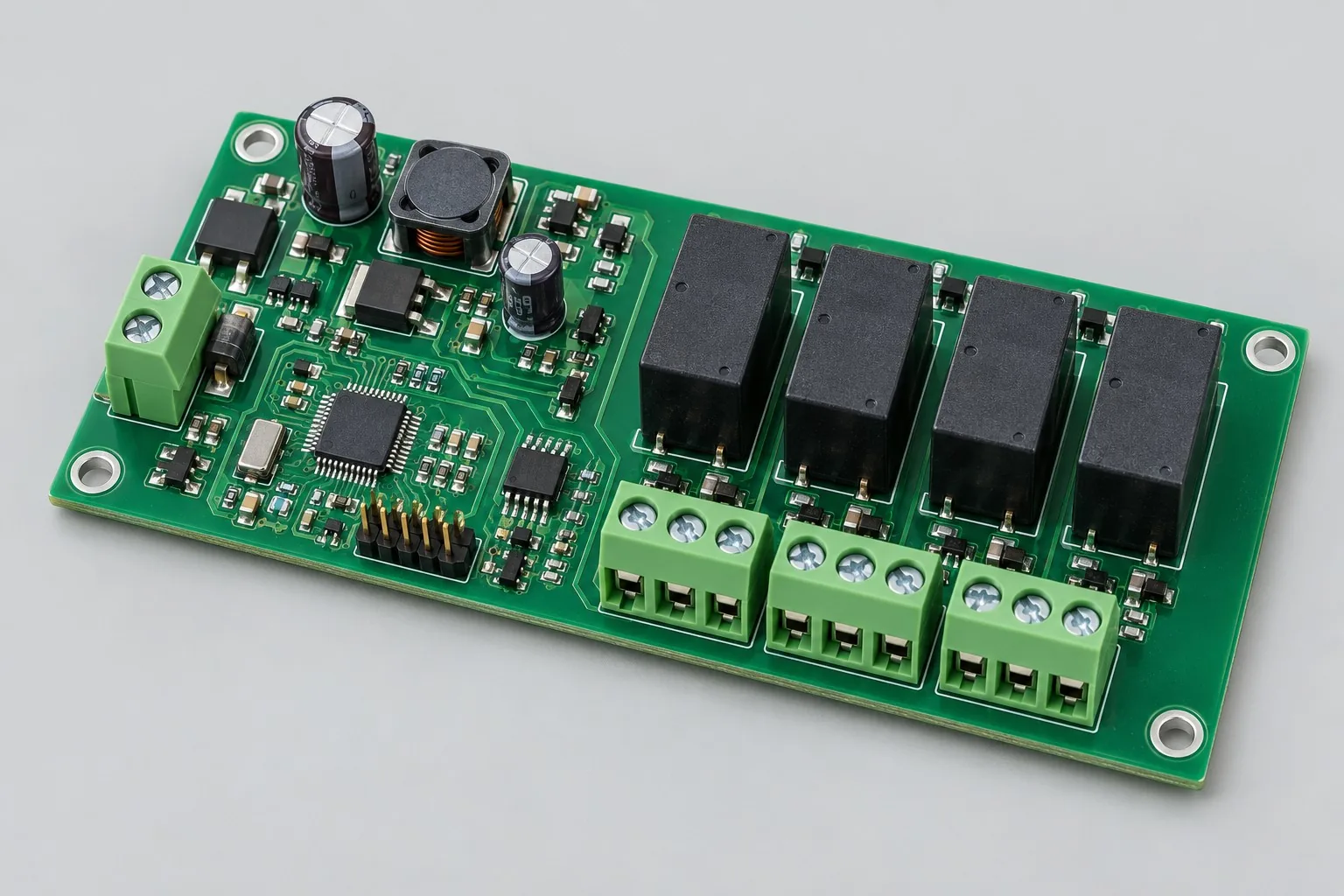
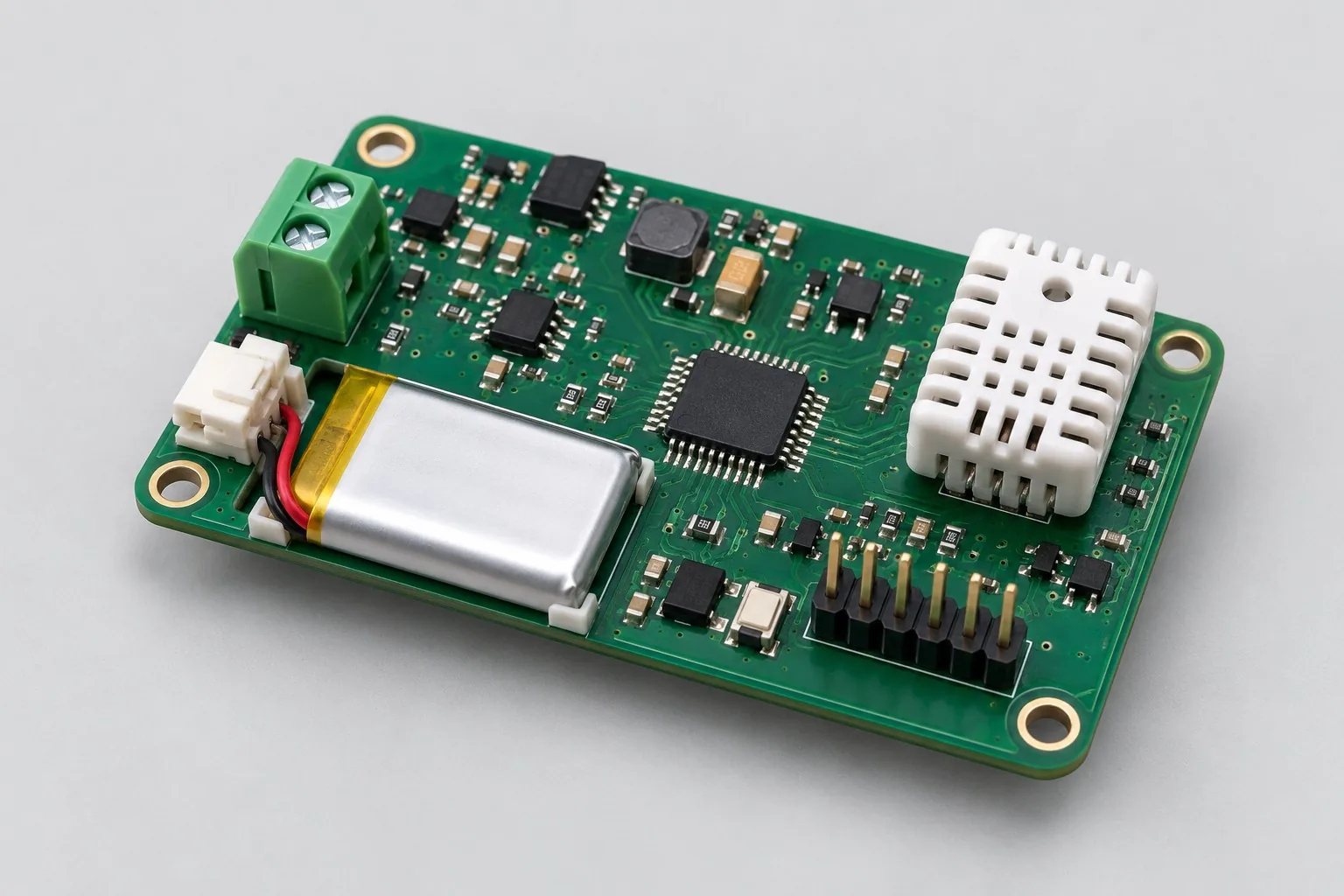
24V four-channel relay control board design · Battery-powered environmental sensor node design
Return single/double-sided PCB design selection · Select solution by device function · Consult This Proposal R&D Team
Documentation Basis and Boundaries
Chinese documentation | DRV8833 device reference in Chinese: selection conditions and board-level validation: DRV8833 is referenced only for applicable motor drives. Validate portions, stall thresholds, and feeding behavior after power loss with the actual mechanism and firmware.