Engineering reference design · prototype validation pending
Tunable-white design: warm/cool dual-channel mixing
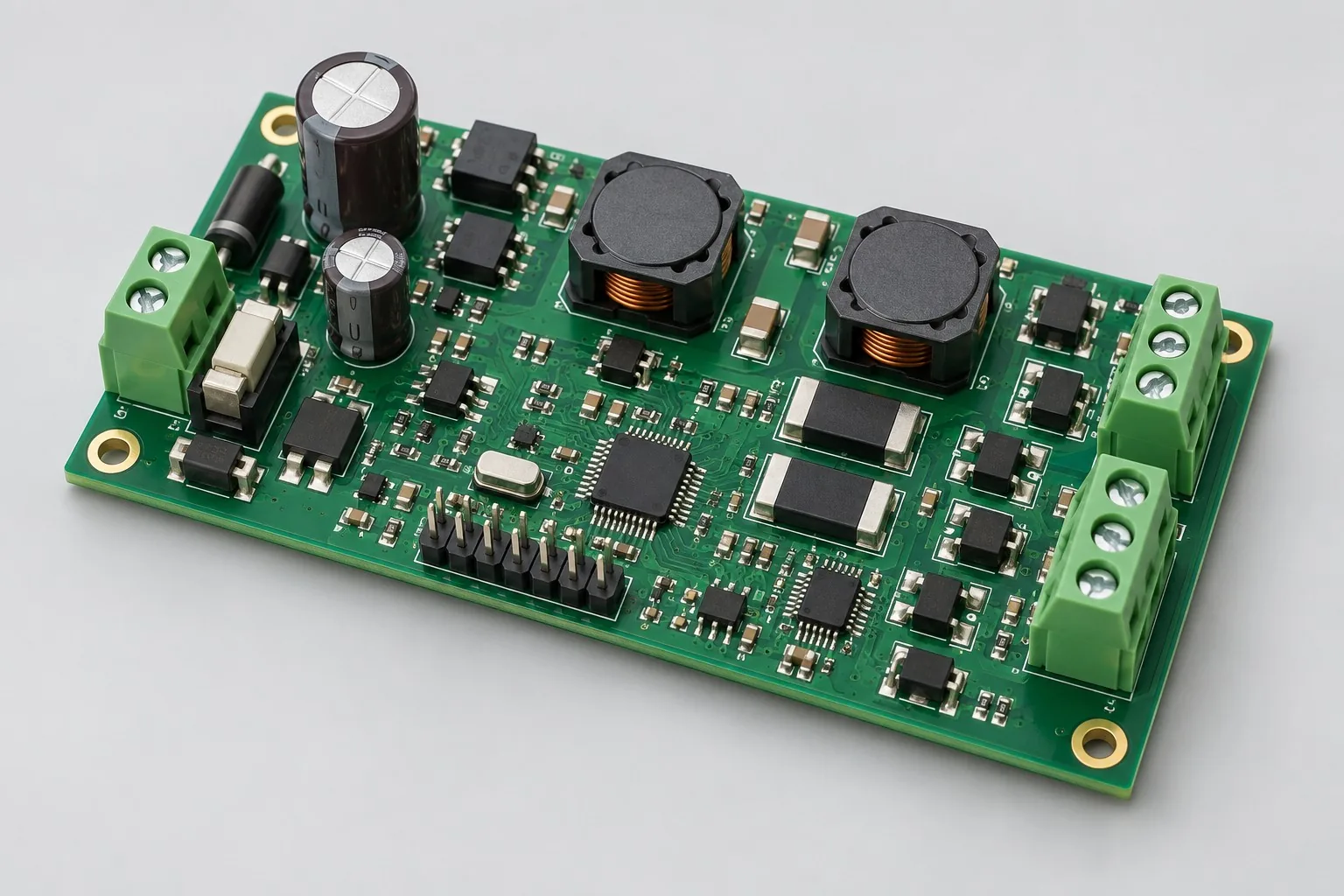
Tunable-white designs combine warm/cool LEDs, independent current drivers, and temperature feedback. Map current/dimming to CCT/illuminance using actual bins, diffusers, and distance. Compare separate LED/driver boards first.
Custom development reference design. The parameters below are requirement configurations and design targets; validate product performance through agreed prototype tests.
| Functional Partition | Design and verification scope |
|---|---|
| Dual-color temperature LED channel | Select warm/cool bins, string counts, and optical windows; define boards by alternating placement and heat density. |
| Dual-Channel Constant Current Regulation | Check each independent channel's Vf, example 350mA target, and drive headroom. |
| Mixed Light Control | Dual PWM/MCU mixing uses measured lookup tables; duty ratios do not directly establish CCT. |
| Optical / LED Board Output | Freeze diffusers/lenses/distance as optical interfaces; mistake-proof harnesses/terminals. |
| Input and Thermal Management | Review 24V input and simultaneous channel heat together; hotspot sensing supports derating. |
| Color Temperature / Current Calibration | Calibrate current/CCT/illuminance at fixed lots/positions; check cold-to-steady thermal drift. |
How much does tunable-white LED design cost, and how are quotes calculated?
Separate dual drives from full mixing calibration. Warm/cool lots, optics, and integrated/separate boards affect layout/software/tests. Quote current control, mixing settings, optical calibration, and prototype assembly separately. Equal LED counts do not mean equal development fees.
Quotation terms depend on the approved files, quantity, material supply, tests and delivery requirements.
Prepare a structured RFQ or use the short inquiry form.
| Quotation Items | What services are included | What to Check When Comparing Quotes |
|---|---|---|
| Circuit and PCB Design | Warm/cold dual-channel and mixed light control | Reusable portions of existing designs and circuit/mechanical changes |
| Software and Validation | LED Bin Sorting, Thermal Drift, and Optical Calibration | Current dimming and CCT measurements are different deliverables |
| Prototype Preparation | Bare PCB, BOM procurement, assembly, and agreed prototype quantity | Whether material/component revisions, prototype quantities, and test targets match |
| Subsequent Revision | Record new requirements separately from post-test corrections | How agreed changes, source files, and validation results are delivered |
How should tunable-white and RGBW boards be selected?
Tunable-white mixes warm/cool whites; RGBW adds color channels/control. Choose by color tasks/channel counts. Shared dimming capability does not make designs equivalent.
Should tunable-white boards integrate or separate drivers and LEDs?
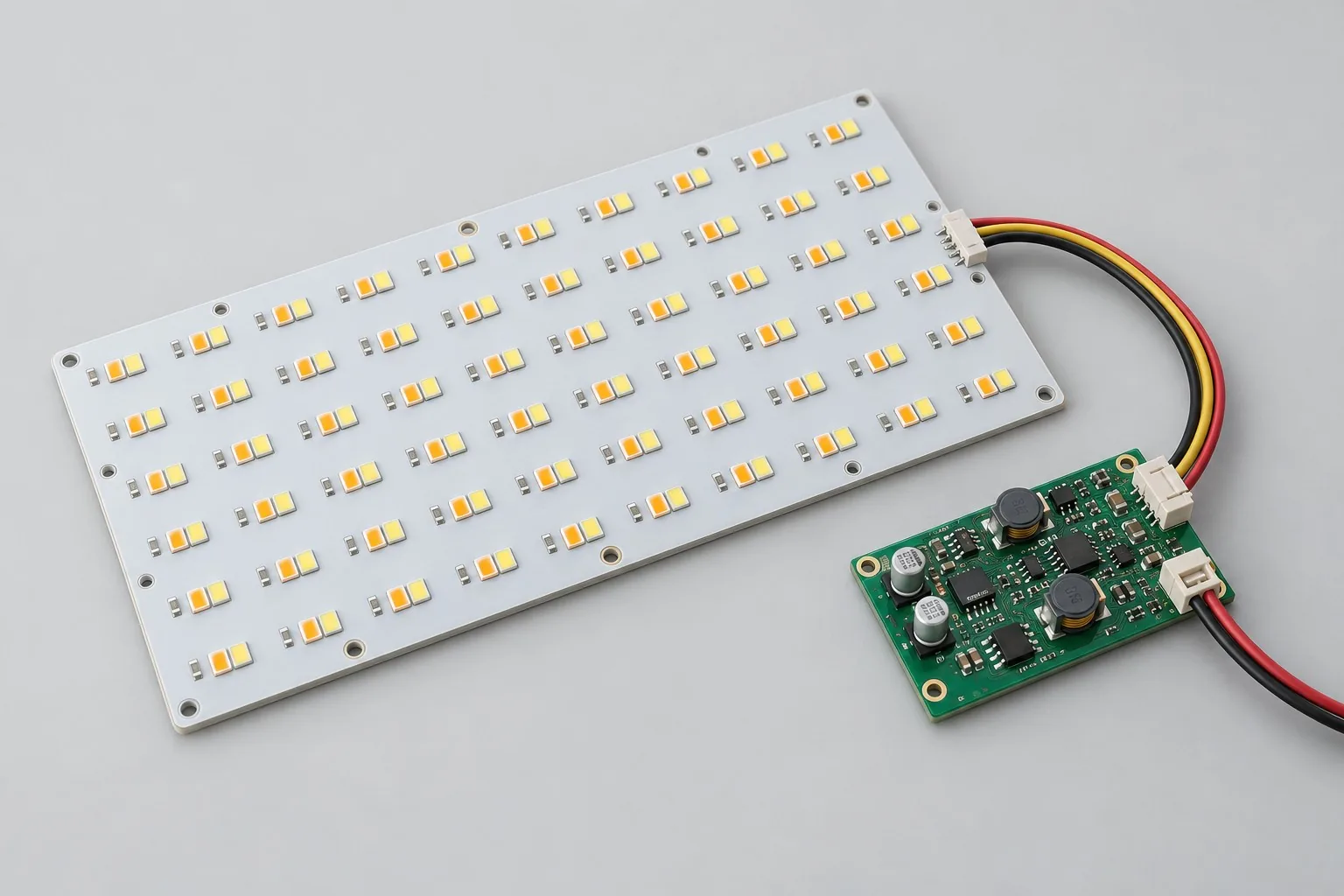
Integrated boards balance heat/optical layouts. Separate boards add connections but separate power/LED placement. Compare space, harnesses, and cooling, including interfaces/assembly verification in quotes.
Do tunable-white design fees include CCT calibration?
Dimming and CCT measurement differ. CCT settings need LED lots, optics, positions, and calibration tables. Uniform placement is not optical verification.
Reference Configuration for Warm/Cool White Dual-Channel Mixed Lighting
| Configuration Field | Reference Configurations/Selections | Basis and Status |
|---|---|---|
| Finished Product Function | Warm-white and cool-white LED mixing | Design Objective |
| LED Configuration | 2 series LED groups; counts defined by voltage drops | Design Objective |
| Power Input Reference | 24V DC; two independent constant-current channels | Design Objective |
| Current Target | 350 mA per channel as a requirement example | Design Objective |
| Dimming Interface | 2 Channel PWM or Digital Control MCU | Design Objective |
| Light Board Structure | FR-4 or aluminum-core board by thermal budget | Design Objective |
| Layout Target | Alternating warm/cool LEDs around optical windows | Design Objective |
| Control Protection | Temperature sensing, thermal derating, and open-circuit diagnosis | Design Objective |
| Connection Method | LED Board and Driver Subassembly + Connector Locking | Design Objective |
| Optical Input | Lenses/diffusers, distance, and illuminance targets | Design Objective |
| Calibration Data | Measured dual-channel current/mixing lookup tables | Design Objective |
| Validation outputs | CCT/illuminance uniformity, dimming, and thermal maps | Design Objective |
LED Board Subassembly and Optical Calibration
Separate boards move driver heat outside the optical region; a single board reduces wiring but requires LED thermal-coupling assessment.
Channel duties do not directly correspond to CCT; calibrate actual LEDs/diffusers.
Aluminum-core candidates address denser LED heat; retain standard FR-4 for controls where appropriate.
Design budget and trade-off examples
Check design targets with engineering calculations
At channel currents 0.2A and 0.3A, total is 0.5A, but CCT is not linear current interpolation. Calibrate at fixed LED lots/optical conditions.
Conditions and Scope of Application:Added currents do not mean linear optical mixing. Verify brightness, flicker, and thermal changes using agreed measurement methods.
Replace examples with selected components and record margins; calculations support design choices, while prototype records support acceptance.
Warm/cool dual-channel mixing power and layout
- Place LEDs at optical pitch, balance group wiring resistance, and avoid heat concentrations.
- Place sensors at expected hotspots, not cool edges; verify with measured thermal maps.
- Review LED/driver polarity, returns, and cable drops together.
Dual Color Temperature LED Board R&D Input
- LED part numbers/bins, CCT range, and distance
- Diffuser/lens drawings and optical windows
- Ambient, heat sinks, and dimming/flicker requirements
If circuit files exist, provide editable schematics, PCB, BOM, and current issues, and agree on review or revision scope. If only functions are defined, freeze this page's inputs before selection and circuit development. Agree separately on control-software and external-application responsibilities, interfaces, and acceptance.
Dual Color Temperature LED Board Phase Delivery
| Stage | Engineering Work for This Proposal | Reviewable Deliverables |
|---|---|---|
| Requirements and Design Freeze | Freeze bins, CCT/brightness, optical windows, and separate-board construction | Functional/interface requirements, mechanical revision, acceptance conditions, and open items |
| Schematic and Component Selection | Design dual current regulation, PWM/temperature feedback, and LED connections | Editable schematics, controlled BOM, footprint checks, and design calculations for these circuits |
| Layout and Routing | Implement pitch, balanced resistance, hotspot points, and thermal interfaces | PCB source files, actual stackup/hole/net constraints, DRC, and assembly-dimension checks |
| Simulation/Calculation | Calculate headroom, dual-channel losses/coupling; define calibration settings | Design calculations/models, input conditions, margins, and items awaiting measurement |
| Prototype and Software | Build LED/driver prototypes; integrate mixing/derating and prepare calibration | Manufacturing package, LED/driver prototypes, bins, dual mappings, optical tables; optional firmware by scope |
| Testing and Version Closure | Measure mixing, uniformity, drift, single-channel opens, and wiring states | Procedures, wiring, raw results, and decisions for the prototype revision; include issue/change and limitation lists |
Dual-color temperature mixed light and thermal drift verification
- CCT, illuminance, and uniformity across mixing settings
- Optical drift from cold start to thermal steady state
- Dual-channel action, open circuit, and thermal derating
- LED hotspots, harness drops, and connector heating
Measure mixing, uniformity, drift, opens, and wiring. Reports identify equipment, conditions, revisions, and criteria, recording passed/uncovered items.
Tunable-white mixing and thermal-drift worksheet
The table turns warm/cool mixing into checks. Freeze samples, equipment, environment, and tolerances; link results to current raw records.
| Verification Object | Pre-Production Freeze | How to Test Prototypes in Practice | Delivery and Acceptance Records |
|---|---|---|---|
| Mixed Color Calibration | Warm/cool lots, CCT settings, and brightness | Measure channels/mixing at fixed distance/optics | Deliver CCT/illuminance/PWM mappings; current ratios alone cannot promise CCT |
| Thermal drift | Ambient, cooling, and stabilization criteria | Compare current/optics from cold startup to thermal stability | Retain time curves/channel temperatures and CCT/illuminance drift |
| Anomaly and Wiring | Separate/integrated boards, harnesses, and overtemperature strategies | Inject single-channel opens and temperature alarms separately | Record remaining-channel response and connector drops; accept against fault-state tables |
Manufacturing and assembly coordination for this design
- Define LED bins and assembly polarity in BOMs/placement drawings.
- Design aluminum-core positioning with compressed thermal-interface construction.
Link design revisions to schematics, BOM, PCB, fabrication, and software documentation. When fabricators adjust stackup, materials, or holes, or Assembly parties propose substitutions, recheck critical electrical and test conditions together.
Common questions on purchasing and customization
How much does tunable-white LED design cost, and how are quotes calculated?
A project-specific quotation requires review of the available files, quantity, materials, requested tests, delivery destination, taxes, shipping, and trade terms. Complete development separately prices circuits, firmware, prototypes, and verification. Any formula on this page organizes cost inputs; it is not a quoted rate.View cost items, calculation conditions, and sources.
How should tunable-white LED lots be compared?
Measure warm/cool and typical mixed settings at equal current, optics, and heat, retaining lots/calibration.
How to inspect low brightness on dual-color temperature prototypes?
Fix settings/methods; check currents/light, switching, and temperatures rather than visible illumination alone.
How should budgets distinguish current control from CCT control?
A dual-350mA baseline drives warm/cool independently. Mixing adds mappings and actual LED/diffuser calibration. List optics, drift, and uniformity by conditions. Dual-PWM pricing does not cover complete CCT delivery.
Which optical conditions must customers freeze before tunable-white layout?
Confirm LED centers, alternating placement, optics, and distance with board mechanics, then driver interfaces/24V. If optical positions are unresolved, review mechanical/optical/electrical layout first. Routed PCBs do not establish uniform mixing.
Does existing dual PWM still need mixing tables?
Duty is not CCT. Measure actual LEDs, temperatures, and optics for mappings. Existing interfaces may remain; targets determine tables/settings/derating. Independent illumination alone need not buy full CCT calibration.
How should tunable-white sources/calibration be delivered?
Agree LED lots/positions, drive parameters, sensing, optics, and PCB sources. Control packages include tables/settings/revision recovery. Record distance/environment/heat so later LED/board changes can assess old tables.
What work is added when separate tunable-white boards become integrated?
Co-located drive heat/LEDs alter optics, coupling, and routing, requiring new layout/thermal review. Old tables are comparison baselines; verify drift/uniformity again. Connector savings alone do not establish cheaper development.
Can tunable-white designs be reused for RGBW scene lights?
Reuse some dimming/temperature tools. RGBW adds colors, mixing maps, concurrent power, and calibration. Two-channel tables cannot describe four colors. Separate retained tools from new channel/optical work rather than multiplying only channel counts.
How should RFQ files be prepared for tunable-white LED design?
Initially describe functions, uses, and files. Quotes confirm LED numbers/bins/CCT/distance; optical drawings/windows; ambient/cooling/dimming/flicker. Supply editable schematics/PCB/BOM or fault-prototype revisions/reproduction records. List missing-data reviews to avoid differing assumptions.
How should tunable-white prototype verification costs be compared by condition?
Fix quantities, revisions, equipment, and criteria. Separately check mixing: frozen lots/CCT/brightness, fixed-distance/optics channel measurements; drift: fixed ambient/cooling/stability, cold-to-hot current/optics; faults/wiring: fixed integrated/separate approach/harnesses/thermal strategy, single-channel opens/alarms. Specify raw-data/issue-closure delivery. One power-on pass is not full verification.
Compare related designs and plan the next step
24V constant-current LED driver control board design · RGBW four-channel constant-current color-mixing control board design
Return LED PCB Design Selection · Select solution by device function · Discuss your design requirements
Documentation Basis and Boundaries
Engineering reference | LM3409 selection conditions and board verification: LM3409 documents support only circuits using that controller; CCT, illuminance, and mixing tables require actual optical-combination verification.