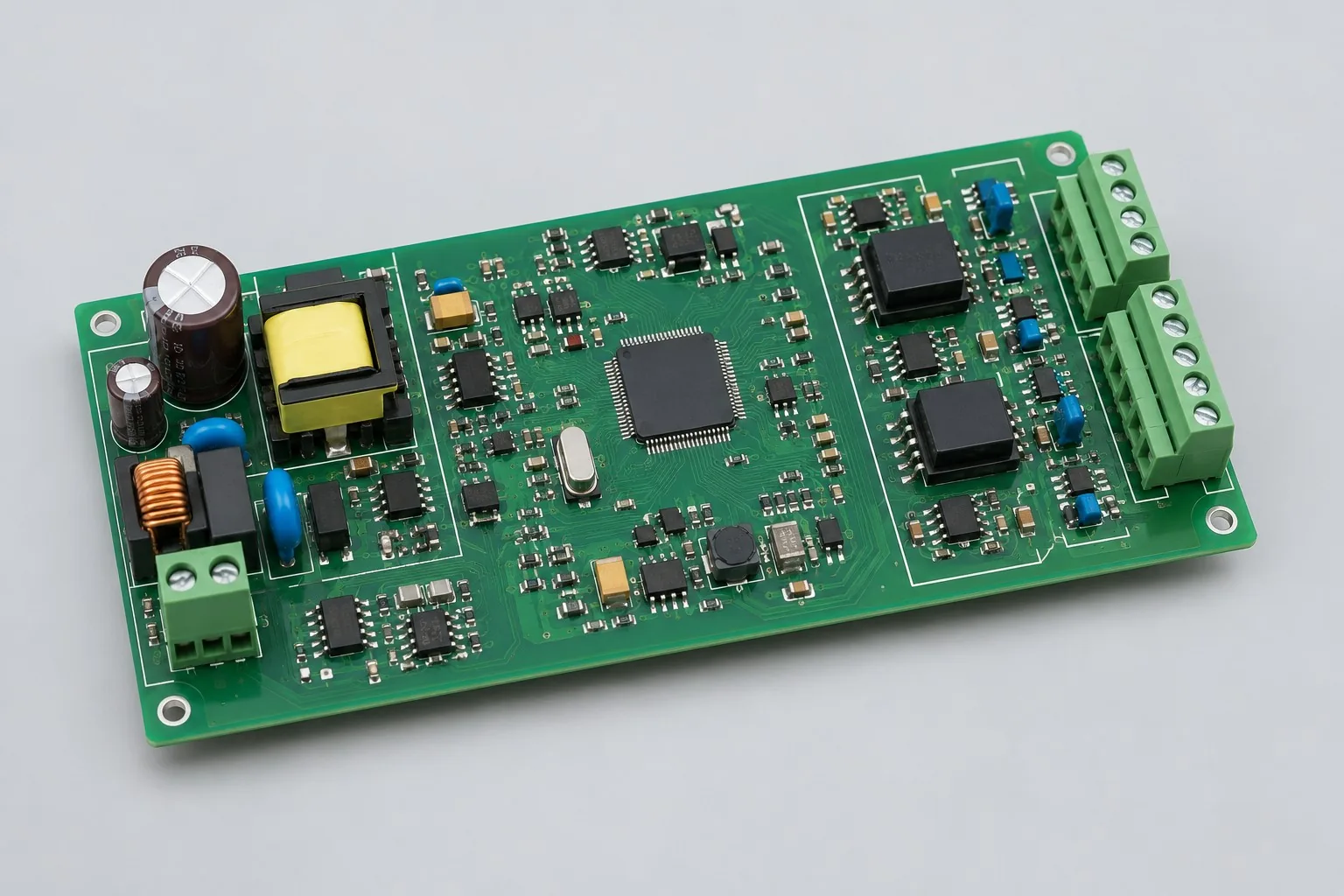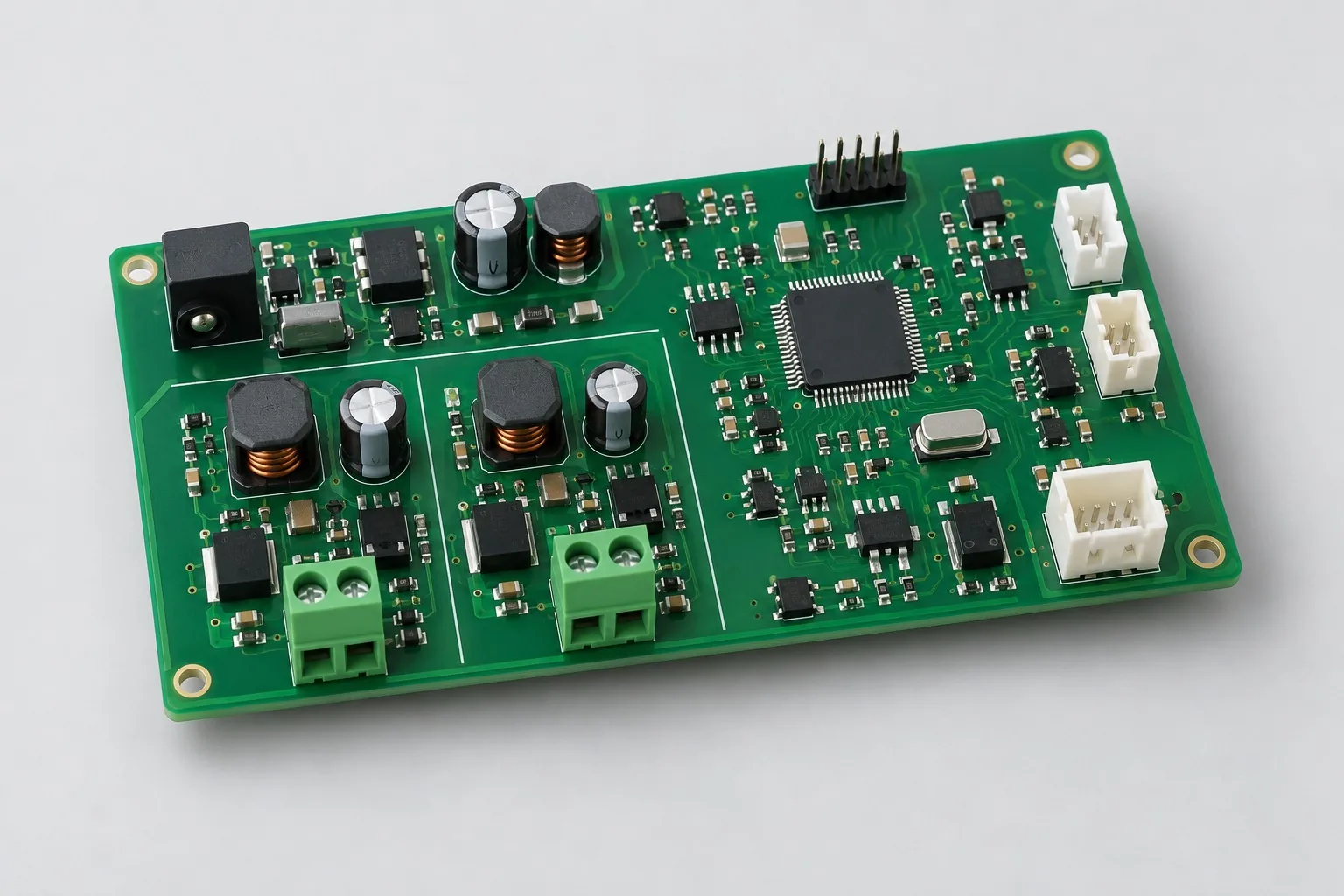
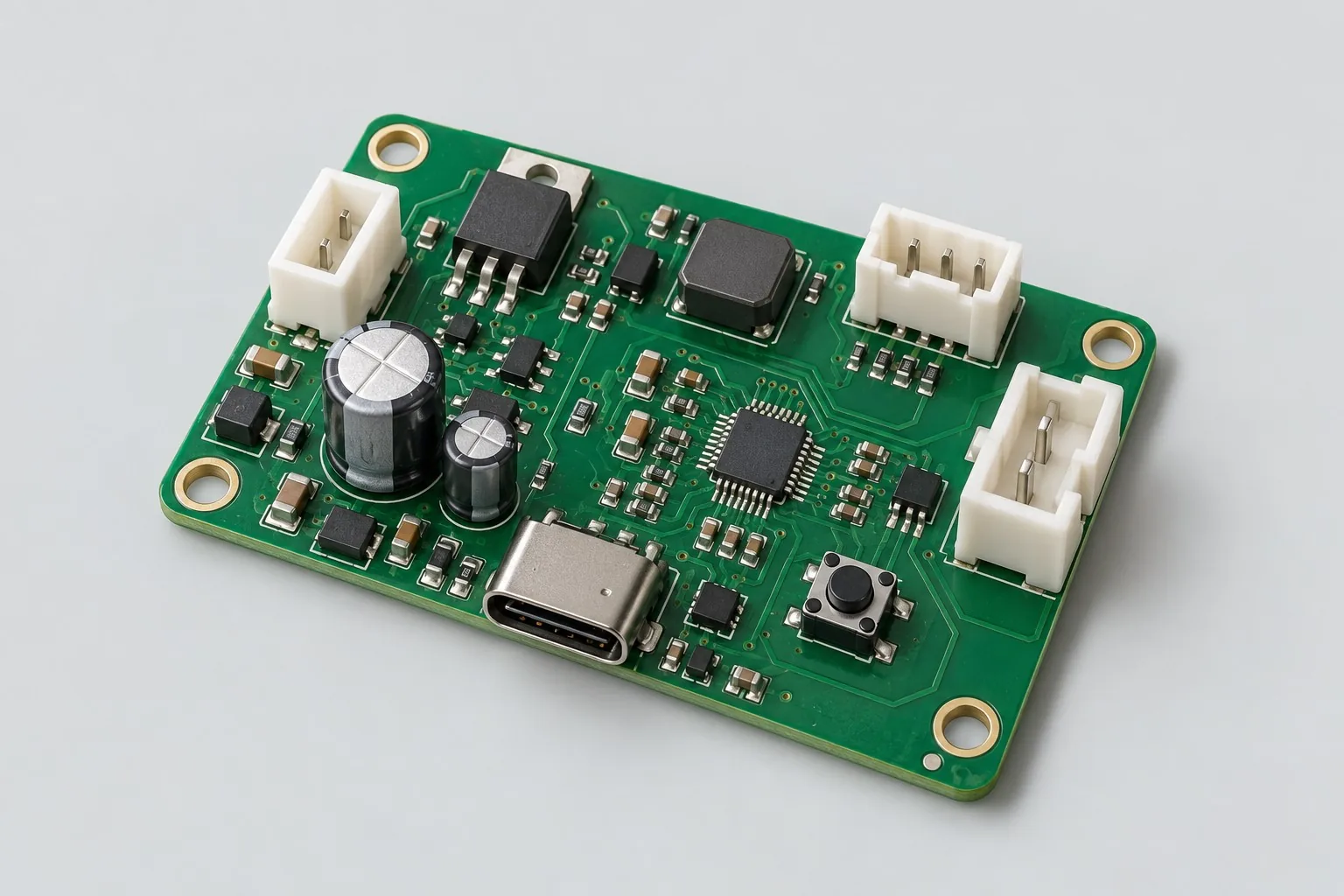
Engineering reference design · prototype validation pending
Pet fountain design: water-level-to-pump control
Pet fountain controllers use level inputs/state machines for low-voltage pumps, providing timed operation, dry-run stopping, and stall alarms. External 5V and halogen-free laminates are reference requirements. Review startup, wet-area mechanics, and recovery together.
Custom development reference design. The following parameters are requirement configurations and design targets; validate functions and performance through agreed prototype tests.
| Functional Partition | Design and verification scope |
|---|---|
| Level / Button Input | Define level-switch active states, buttons, and readback options; distinguish disconnected sensors from normal levels. |
| Control State Machine | The controller manages timed/manual operation, low-water stopping, and stall alarms; agree automatic recovery conditions separately. |
| Water Pump Driver | Select MOSFETs/load switches by startup/stall current and flyback needs, not unloaded values alone. |
| Pump / Indicator output | Mistake-proof pump terminals. LEDs/buzzers indicate faults by state tables, not instead of stopping. |
| Low-voltage power supply and protection | Check USB 5V input, adapters, and harness drops; record MCU power/resets during pump switching. |
| Low-Water / Stall Detection | Inject low water, stalls, and sensor disconnections separately; check stops, limited retries, and persistent-fault heating. |
How much does pet fountain controller design cost, and how are quotes calculated?
Costs mainly depend on level sensing, pump drives, and fault handling. Simple timing differs from low-water/stall/recovery development. Wet-area structures affect interface tests. Separate hardware, local firmware, actual-pump integration, and prototype builds; list apps and complete protection separately.
Quotation terms depend on the approved files, quantity, material supply, tests and delivery requirements.
Prepare a structured RFQ or use the short inquiry form.
| Quotation Items | What services are included | What to Check When Comparing Quotes |
|---|---|---|
| Circuit and PCB Design | Level sensing, pump control, and low-water/stall handling | Reusable portions of existing designs and circuit/mechanical changes |
| Software and Validation | Wet environment interface and recovery test | Board level/pump functions, complete waterproofing, and drinking-health analysis are different services |
| Prototype Preparation | Bare PCB, BOM procurement, assembly, and agreed prototype quantity | Whether material/component revisions, prototype quantities, and test targets match |
| Subsequent Revision | Record new requirements separately from post-test corrections | How agreed changes, source files, and validation results are delivered |
Should pet fountains use simple timing or level feedback?
Timing controls cadence only. Level feedback helps identify low water but adds sensing/fault handling. Select by actual pump/water-path structures; timing alone does not replace protection.
How should fountain pumps and supplies be selected?
Check operating/startup/fault currents and external supply capacity for target conditions. Select pump interfaces, harnesses, and protection together, not supplies by average power alone.
Do fountain development fees include waterproofing and health monitoring?
Level/pump functions, complete waterproofing, and drinking-health analysis are separate. List actual sensing/test targets. A water-level input does not provide health diagnosis.
Water-level-to-pump control reference configuration
| Configuration Field | Reference Configurations/Selections | Basis and Status |
|---|---|---|
| Reference application | Low-voltage pet-fountain pump and water-level control | Illustrative configuration; prototype validation required |
| Reference Function | Pump start/stop, level sensing, and low-water protection | Design Objective |
| Power Supply Objective | USB 5V External Power Supply Requirements Example | Design Objective |
| Actuator Configuration | 1 low-voltage DC pump, selected by stall current | Design Objective |
| Sensing Interface | Level switch + optional Hall/current readback | Design Objective |
| User Interface | Buttons, LED states, and optional buzzer | Design Objective |
| Main Controller Configuration | Low-power MCU + MOSFET/load switch | Design Objective |
| Layer Candidate | 2 layer halogen-free FR-4 | Design Objective |
| Material Requirements | Specify grades and halogen-free declarations; not complete product certification | Design Objective |
| Protection Structure | Separate wet/dry zones; complete product design defines coatings and drainage | Design Objective |
| Firmware Function | Low-water stopping, stall alarms, and timed operation | Design Objective |
| Validation outputs | Pump control, safe states, wet-environment, and power records | Design Objective |
External power supply and dry-run stall strategy
An external low-voltage supply moves mains conversion into the adapter; adapter and complete-unit safety boundaries still need checking.
Select drives by stall rather than no-load current, with independent low-water/stall fault logic.
Halogen-free requirements and waterproof design proceed together; labels do not replace protection verification.
Design budget and trade-off examples
Check design targets with engineering calculations
Assuming pump operation at 0.3A and startup at 0.9A, do not size drives/supplies only for 0.3A. With MOSFET on-resistance 0.1Ω, conduction loss at 0.9A is 81mW.
Conditions and Scope of Application:This excludes switching losses, thermal resistance, and fault duration. Verify low-water, stall, and power-loss recovery separately.
Replace examples with selected components and record margins; calculations support design choices, while prototype records support acceptance.
Fountain level-to-pump power and layout
- Separate pump power/returns from sensing returns; place MOSFET/flyback parts near pump connectors.
- Protect level inputs and prevent backfeed; orient connectors for drip paths.
- Define coating keepouts, button/LED windows, and drainage with the enclosure.
Pet-fountain controller design inputs
- Pump voltage, startup/stall current, and cable length
- Level sensing, cleaning method, and wet-area structure
- Halogen-free definition, adapter, and fault behavior
If circuit files exist, provide editable schematics, PCB, BOM, and current issues, and agree on review or revision scope. If only functions are defined, freeze this page's inputs before selection and circuit development. Agree separately on control-software and external-application responsibilities, interfaces, and acceptance.
Pet-fountain controller phase deliverables
| Stage | Engineering Work for This Proposal | Reviewable Deliverables |
|---|---|---|
| Requirements and Design Freeze | Freeze pumps, level detection, cleaning/wet areas, materials, and recovery | Functional/interface requirements, mechanical revision, acceptance conditions, and open items |
| Schematic and Component Selection | Design level inputs, MCU, pump drive, prompts, and 5V protection | Editable schematics, controlled BOM, footprint checks, and design calculations for these circuits |
| Layout and Routing | Separate pump/sensing returns; implement wet/dry zones, drips, and coating keepouts | PCB source files, actual stackup/hole/net constraints, DRC, and assembly-dimension checks |
| Simulation/Calculation | Budget startup/stall supply, drive dissipation, and sustained-fault heat; check material files | Design calculations/models, input conditions, margins, and items awaiting measurement |
| Prototype and Software | Build watering prototypes; integrate timing, low-water/stall prompts, harnesses, and enclosures | Manufacturing package, watering prototypes, agreed state-machine firmware, level/pump interfaces, recovery notes, and material declarations |
| Testing and Version Closure | Test low water, stalls, disconnections, and power recovery; check functions after wet-environment prechecks | Procedures, wiring, raw results, and decisions for the prototype revision; include issue/change and limitation lists |
Pump protection and wet-environment verification
- Low water, stalls, disconnected sensors, and false-detection recovery
- Power/MCU reset checks during pump switching
- Specified humidity/condensation and cleaning test plans
- Continuous-run heating, noise, and standby current
Test low water, stalls, disconnections, and recovery; check functions after wet-environment prechecks. Reports identify equipment, conditions, revisions, and criteria, recording passed/uncovered items.
Pet-fountain protection and wet-environment validation worksheet
The table turns level-to-pump control into executable checks. Freeze samples, equipment, environment, and tolerances; link results to current raw records.
| Verification Object | Pre-Production Freeze | How to Test Prototypes in Practice | Delivery and Acceptance Records |
|---|---|---|---|
| Low Water Protection | Level sensing, false-detection conditions, and pump stopping strategies | Simulate low water, sensor disconnections, and stalls | Retain state timelines/drive current; check automatic recovery against approved safe states |
| Wet Environment Boundary | Cleaning/condensation, enclosure sealing, and coating keepouts | Check power, sensing, and appearance after approved environmental plans | Deliver environmental treatment/inspection records; external 5V does not mean waterproof equipment |
| Pump and Power Supply | Pump startup/stall currents, supply, and harnesses | Repeat start/stop while monitoring USB input/MCU power | Retain drops, resets, and heating; distinguish adapter limits from board return issues |
Manufacturing and assembly coordination for this design
- Review pump terminal soldering/harness pull strength with sealing.
- Archive material declarations separately from coating records;Assembly Fixtures avoid water contamination at electronic workstations.
Link design revisions to schematics, BOM, PCB, fabrication, and software documentation. Recheck critical electrical and test conditions when fabricators adjust stackup, materials, or holes or assemblers propose substitutes.
Assembly/testing for this board: drinking/purification equipment PCB assembly and test configurations. Design covers source files, component selection, and validation targets; PCB assembly sources/receives materials, assembles, programs agreed files, and performs production tests against approved BOMs. This link opens a production configuration for the functional area; it does not mean both pages share a physical model.
Common questions on purchasing and customization
How much does pet fountain controller design cost, and how are quotes calculated?
A project-specific quotation requires review of the available files, quantity, materials, requested tests, delivery destination, taxes, shipping, and trade terms. Complete development separately prices circuits, firmware, prototypes, and verification. Any formula on this page organizes cost inputs; it is not a quoted rate.View cost items, calculation conditions, and sources.
How to accept water dispenser low-water alarm?
Use actual water paths to define normal, low-water, and sensor-fault states. Check stops, prompts, and post-refill recovery.
Does the Water Pump Replacement Require Redesign?
Check interfaces, startup/stall currents, and control methods before retaining drives/protection, then regress water-path/fault tests.
How should fountain budgets first limit basic functions?
List USB 5V, one pump, level switch, low-water stops, and stall alarms, prototyping actual pumps/paths. List Hall/current readback, buzzer, and network options separately; confirm wet/dry zones/coatings. This prevents basic control and monitoring becoming incomparable totals.
Which protection circuits must be provided for fountain layout-only work?
Confirm startup/stall currents, MOSFET/load switch, harnesses, level interfaces, and entry protection. Layout arranges returns/wet interfaces; low-water/sensor-fault logic belongs to firmware. A request stating only automatic dispensing needs circuit/state review first.
Can low-water firmware stop pumps solely from level switches?
Also define debounce, disconnected switches, refill recovery, and pump faults to avoid chatter. Existing timing/button firmware may be reused, but actual water-path/stall tests remain separate. Level readings do not replace protection behavior.
Which maintenance parameters should fountain sources include?
Agree pump models/harnesses, drive protection, level wiring, grades, and hardware sources. Firmware includes timing, alarms, and recovery, with prototypes linked to water paths. This supports startup/current and low-water decisions after pump changes, beyond fabrication drawings alone.
What development costs does current readback add?
Add sensing, range/noise, possible ADC interfaces, and startup/stall criteria. Original pump firmware may remain, but false alarms, stall stops, and recovery need actual-pump retesting. A resistor/Hall part's price is not complete diagnostic development.
Can basic fountain boards become aquarium controllers?
Assess reuse of one-pump/level logic, but aquarium temperature, two lighting outputs, schedules, and concurrent loads are new. USB 5V cannot directly serve 12V pump/light combinations. Recheck power/fault states; shared wet environments do not establish interchangeable circuits.
How should RFQ files be prepared for pet fountain controller design?
Initially describe functions, uses, and files. Quotes confirm voltage/startup/stall/cables; sensing/cleaning/wet areas; halogen-free definitions/adapters/faults. Provide editable schematics/PCB/BOM or fault-prototype revisions/reproduction records. List missing-data review tasks to avoid differing assumptions.
How should fountain prototype verification costs be compared by condition?
Fix quantities, revisions, equipment, and criteria. Separately check low-water protection: fixed sensing/false-detection/stopping, simulated low water/disconnections/stalls; wet boundaries: fixed cleaning/condensation/sealing/keepouts, post-environment power/sensing/appearance; pumps/power: fixed startup/stall currents/supplies/harnesses, repeated switching with USB/MCU monitoring. Specify raw-data/issue-closure delivery. One power-on pass is not full verification.
Compare related designs and plan the next step
Halogen-free material communication control board design solution · Smart aquarium low-voltage environmental control board design
Return halogen-free PCB design selection · Select solution by device function · Discuss your design requirements
Documentation Basis and Boundaries
Engineering reference | TPS22918 Chinese-language device reference: selection conditions and board-level validation: TPS22918 is only a load-switch reference under applicable supply conditions; pump current, flyback, and protection follow actual drive/product configurations.