Engineering Reference Configuration
Air-conditioner control board assembly: configuration, testing, and deliverables
The following adjustable engineering configurations support material, functional, and process review; they are not stocked models or commitments to current production-line capabilities. Approved fabrication documentation and order acceptance requirements govern.
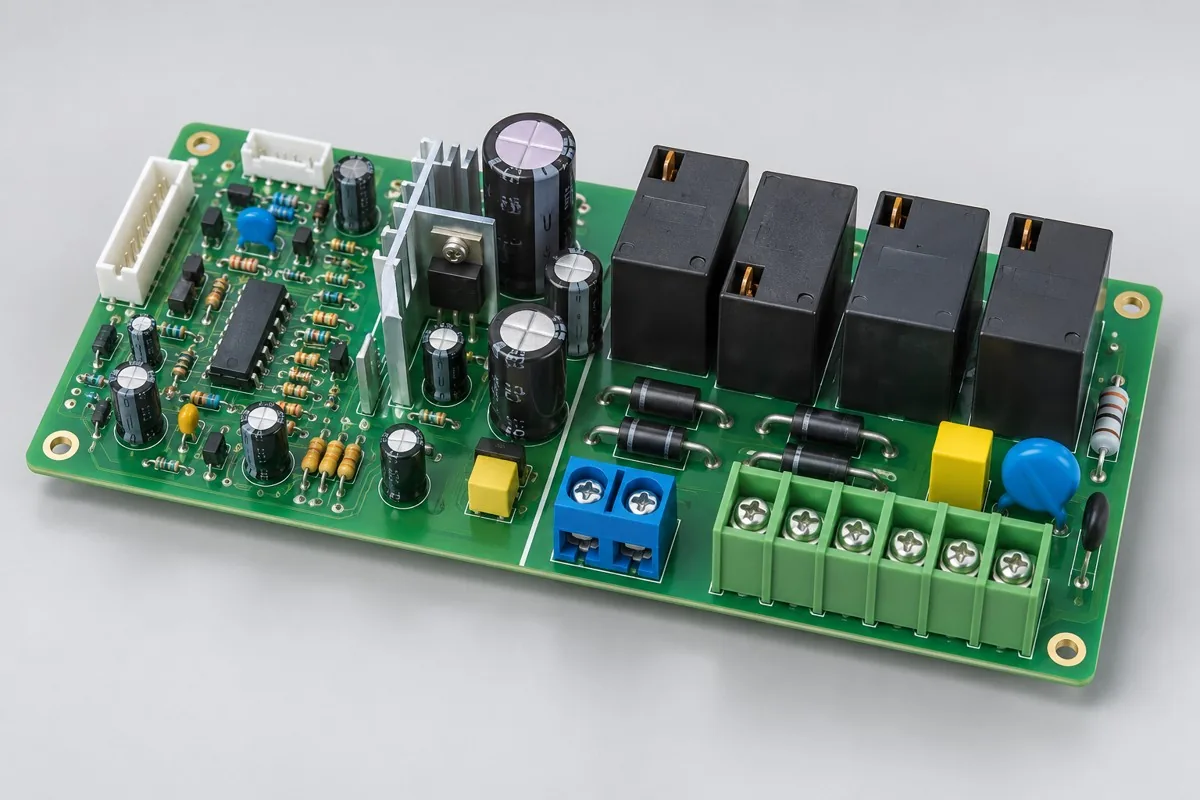
Air-conditioner control board through-hole assembly supports contract manufacturing and procurement review for compressor/fan relays and temperature inputs. First confirm MCU + relay drives + temperature sampling, baseline 2 relay outputs, NTC inputs, display/button interfaces, and 2/4-layer FR-4 with defined mains/low-voltage boundaries. Then compare SMT → lead forming → soldering → cleaning inspection → functional testing scope and acceptance costs for sensor simulation, load timing, fault exits, and wiring checks. This page distinguishes control board + wiring/parameter table + functional results from compatibility with specified air-conditioning equipment, with complete-unit electrical safety defined separately, helping assess whether quotations cover actual use. RFQ information reference:BOM · bare board · material supply
Reference specification and configuration options
| Options | Reference Configuration |
|---|---|
| Power and Logic Domains | Low-voltage control supply; separate mains-load region |
| Functional Module | Compressor/fan relays and temperature inputs |
| Core Components/Architecture | MCU + relay drives + temperature sampling |
| Interface and Channels | Baseline 2 relay outputs; NTC inputs; display/button interfaces |
| Board Layers and Material Options | 2/4-layer FR-4; defined mains and low-voltage boundaries |
| Component types | Through-hole relays/terminals, SMD MCU and protection components |
| Assembly Route | SMT → lead forming → soldering → cleaning inspection → functional testing |
| Material Supply Scope | Specified relays/terminals/fuses; standard control components sourced |
| Firmware and Parameters | Temperature control, startup delay, faults, and status display |
| Test Focus | Sensor simulation, load timing, fault exits, wiring checks |
| Deliverables | Control board + wiring/parameter table + functional results |
| Configuration Limits/Options | For specified air-conditioning equipment; define complete-unit electrical safety separately |
How much does air-conditioner control board through-hole assembly cost, and what does the quotation include?
Relays, terminals, fuses, temperature inputs, and controllers comprise materials. Price lead forming, soldering, low-voltage/mains-region inspection, temperature-control tests, and startup-delay tests separately; list complete-unit electrical safety, compressors, and fans according to actual scope.
Quotation terms depend on the approved files, quantity, material supply, tests and delivery requirements.
Prepare a structured RFQ or use the short inquiry form.
| Cost Item | Scope for This Configuration | Billing frequency and work scope | Procurement Verification |
|---|---|---|---|
| Bare PCB and core components | MCU + relay drives + temperature sampling; 2/4-layer FR-4; defined mains and low-voltage boundaries | Price according to actual bare-board/component purchase quantities; authorize critical components and substitutions individually | Specified relays/terminals/fuses; standard control components sourced |
| Placement and Post-Assembly | SMT → lead forming → soldering → cleaning inspection → functional testing | Feeder/program setup per lot; assembly priced per board, joint, or process as agreed, with counting rules specified | Through-hole relays/terminals, SMD MCU and protection components |
| Manufacturing Preparation | Review stencils, first articles, and support tooling against the actual assembly route | New stencils/carriers may be separate one-time charges; verify panelization, revision, and condition before reuse | Reduced quantities do not automatically eliminate first-article or feeder setup |
| Functional Support | Sensor simulation, load timing, fault exits, wiring checks | Itemize test-method/fixture/script setup; agree execution charges per board, channel, or test duration | Separate supporting development from execution records for each board |
| Software and Parameters | Temperature control, startup delay, faults, and status display | When firmware exists, distinguish file programming/verification from software development; omit programming without a firmware revision | Customer-approved files, parameters, and readback rules determine scope |
| Delivery and Change | Control board + wiring/parameter table + functional results; for specified air-conditioning equipment, with complete-unit electrical safety defined separately | Price accessories, retesting, and revision changes by approved work items; do not prefill fixed rates | Check BOM, tooling, programs, and acceptance revisions before reorders |
How do relay air-conditioner control boards differ from variable-frequency drive boards?
Relays provide on/off switching, not variable-frequency speed control. Variable-frequency capability requires separate power-drive and algorithm definitions; comparing relay-board prices alone omits the complete drive task.
| Comparison Metric | Current Conditions | Factors Influencing Procurement Decision |
|---|---|---|
| Manufacturing Delivery | SMT → lead forming → soldering → cleaning inspection → functional testing | Produce boards/assemblies per BOM and assembly drawings; this does not establish that every system function passes |
| Functional Acceptance | Sensor simulation, load timing, fault exits, wiring checks | Compare unit prices after defining test stimuli, limits, accessories, and records; review missing test inputs first |
| Configuration Options | Baseline 2 relay outputs; NTC inputs; display/button interfaces; 2/4-layer FR-4; defined mains and low-voltage boundaries | Confirm circuit/program compatibility before reviewing assembly and test costs for interface, stackup, or component changes |
| Delivery Scope | For specified air-conditioning equipment; define complete-unit electrical safety separately | Complete-system accessories, application development, and project verification are not automatically included in board assembly |
How should NTCs and relays be selected for air-conditioner control boards?
Match NTC resistance curves and sensor installation to software; select relays for loads and surge conditions. Define equipment assignments and startup delays for both outputs; same-size relays or same-plug probes are not directly interchangeable.
- First list the compressor/fan relays and temperature inputs needed, distinguishing build-to-print manufacturing, configuration changes, and new-function development.
- Then freeze complete part numbers for MCU + relay drives + temperature sampling, baseline 2 relay outputs, NTC inputs, display/button interfaces, and 2/4-layer FR-4 with defined mains/low-voltage boundaries. Separate consigned and sourced materials using specified relays/terminals/fuses and sourced standard control components.
- Use first articles to check SMT → lead forming → soldering → cleaning inspection → functional testing and temperature control, startup delay, faults, and status display. If only program files are supplied, agree on programming verification first; review development separately.
- Turn sensor simulation, load timing, fault exits, and wiring checks into acceptance items with stimuli, limits, and records, specifying fixture ownership, per-board execution, and post-rework retests.
- Finally confirm control board + wiring/parameter table + functional results and compatibility with specified air-conditioning equipment, defining complete-unit electrical safety separately. Compare total prices at equal quantities, accessories, and test scope, and freeze order revisions.
Applicable uses and situations requiring separate review
Air-conditioning controllers, temperature-controlled relay equipment.
High-speed variable-frequency compressor drives cannot use relay switching boards directly. Ordinary action tests are insufficient for release if mains/low-voltage isolation design or protection strategies remain unapproved.
Assembly Challenges for This Product
Define through-hole heights, soldering heat, and support for relays and power connectors first. Inspect secondary-soldering splatter, wire strands, and residues at mains boundaries. Error-proof temperature-input connectors; divide wave soldering and manual secondary soldering to prevent heat damage to relays and plastic housings.
Structural, thermal, and configuration trade-offs
Relay switching is simple but does not provide variable-frequency speed control; delayed-restart strategies belong to firmware, not soldering. External power modules reduce onboard heat but add harness and safety-interface responsibilities.
Product-specific test matrix
| Test stage | Inspection/Functional Methods | Acceptance Record |
|---|---|---|
| Temperature Input | Simulate normal, open circuit, and short circuit | Temperature/error code and threshold |
| Action Sequence | Validate fan/compressor startup and shutdown under approved conditions | Relay channels, delay, and interlock |
| Safety Status | Power-loss recovery and sensor fault exit | Default output and alarm records |
Defect Handling and Acceptance
Assess incorrect relay types, wrong NTC parameters, and reversed load wiring separately. Acceptance must check fault-inhibited startup, power-restoration states, and all load channels rather than relay actuation alone.
Air-conditioner relay PCB assembly: material supply and revision control
Lock NTC R/T curves and relay load characteristics; equal resistance or voltage does not establish direct substitutes. Customers supplying wiring provide terminal drawings and wire order; system approval governs mains components.
Prototyping vs. Production Differences
Validate prototype logic with low-energy loads first; production uses error-proof interfaces and sensor-simulation fixtures. Define high-power-load/complete-unit safety test scope and frequency separately.
Delivery Configuration
Control board + wiring/parameter table + functional results. For specified air-conditioning equipment; define complete-unit electrical safety separately.
Convert this configuration into a reviewable order
For air-conditioner relay control board orders, check BOM, quantity, material supply, and conditions below; add pick-and-place files/CPL, DNP items, and assembly drawings for SMT. For programming, provide files, programming rules, and checksums corresponding to temperature control, startup delay, faults, and status display. Review costs separately for materials, SMT → lead forming → soldering → cleaning inspection → functional testing, and required stencils/line setup, support carriers, and test equipment. Reapprove revisions after documentation changes; agree on delivery milestones after kit completion and scheduling confirmation.
| Required project inputs | Engineering Decisions Affected | Records/delivery as agreed in the order |
|---|---|---|
| Compressor/Fan Load | Provide load voltage, current, and start/stop interlocks to determine relay configurations and test loads. | Retain control timing and contact tests per channel; unloaded switching does not cover startup surges. |
| Temperature Protection | Provide probe curves, fault criteria, and power-loss behavior. | Record open/short-circuit and limit-exceedance responses with firmware revisions. |
Air-conditioner control board through-hole assembly FAQ
How much does air-conditioner control board through-hole assembly cost, and what does the quotation include?
Through-hole soldering can be estimated as board quantity × billable points per board × price per point + setup fee. A project-specific quotation requires review of the available files, quantity, materials, requested tests, delivery destination, taxes, shipping, and trade terms. This excludes materials, insertion, and functional testing. Any formula on this page organizes cost inputs; it is not a quoted rate.View cost items, calculation conditions, and sources.
How do relay air-conditioner control boards differ from variable-frequency drive boards?
Relays provide on/off switching, not variable-frequency speed control. Variable-frequency capability requires separate power-drive and algorithm definitions; comparing relay-board prices alone omits the complete drive task.
How should NTCs and relays be selected for air-conditioner control boards?
Match NTC resistance curves and sensor installation to software; select relays for loads and surge conditions. Define equipment assignments and startup delays for both outputs; same-size relays or same-plug probes are not directly interchangeable.
Must air-conditioner control board prototypes connect to a compressor?
Board-level tests can first validate temperature control and timing with approved simulated inputs and controlled loads; define actual-equipment integration separately. Simulation and complete-unit validation need different equipment and workloads.
Why should low-price air-conditioner board quotations include temperature-control software review?
Temperature units, startup delays, and fault exits determine test cases; costs are not simply solder-joint costs. Check software revisions and simulated temperature points to compare whether suppliers provide equivalent functional validation.
Does replacing an air-conditioner board temperature probe require software changes?
Check NTC curves and input circuits; different curves may require parameter or algorithm changes. Separate substitutions and validation in supplier quotations, retaining simulated-temperature points and fault-exit records.
Is compressor startup delay an assembly or software cost?
Loading existing approved strategies is programming and testing; developing new strategies is separate. Manufacturing quotations should identify normal startup, delayed restart, and fault-exit items rather than only confirming relay actions.
How should temperature-input testing be included in air-conditioner control board through-hole assembly procurement acceptance?
The reference method simulates normal, open-circuit, and short-circuit conditions; records include temperature/error codes and thresholds. Provide test inputs, applicable configurations, and acceptance limits first, then agree on first-article validation and per-board execution scope. Price test preparation separately from each execution. Without limits, review methods first rather than labeling completed operations as specification compliance.
How should action-timing testing be included in air-conditioner control board through-hole assembly procurement acceptance?
The reference method validates fan/compressor startup and shutdown under approved conditions; records include relay channels, delays, and interlocks. Provide test inputs, applicable configurations, and acceptance limits first, then agree on first-article validation and per-board execution scope. Price test preparation separately from each execution. Without limits, review methods first rather than labeling completed operations as specification compliance.
How should safe-state testing be included in air-conditioner control board through-hole assembly procurement acceptance?
The reference method checks power-loss recovery and sensor-fault exits; records include default outputs and alarms. Provide test inputs, applicable configurations, and acceptance limits first, then agree on first-article validation and per-board execution scope. Price test preparation separately from each execution. Without limits, review methods first rather than labeling completed operations as specification compliance.
For repeat air-conditioner board orders with changed startup delays, is parameter programming the only charge?
After startup-delay changes, first check existing temperature control and compressor/fan interlocks remain applicable, then validate shutdown, delayed restart, and fault exits under approved conditions. For controlled parameter loading only, list programming/readback and corresponding per-board tests. Strategy or case changes require separate development and test preparation; one parameter change does not eliminate functional review.
Must first-article, stencil, and line-setup charges be recalculated for repeat air-conditioner control board through-hole assembly orders?
The route is SMT → lead forming → soldering → cleaning inspection → functional testing. For SMT, check stencils and panels; for through-hole or later installation, check support and assembly methods. Agree on setup and first articles for this batch; reuse old tooling only when revision, location, and condition match. After changing through-hole relays/terminals, SMD MCU/protection components, or interfaces, review tooling effects and sensor simulation, load timing, fault exits, and wiring checks before confirming recurring charges.
How should total air-conditioner control board through-hole assembly prices be compared when critical components are consigned and others sourced?
Build a procurement responsibility table using specified relays/terminals/fuses and sourced standard control components. Confirm complete part numbers, quantity, packaging, and excess-material rules with materials. Consignment only changes procurement boundaries; SMT → lead forming → soldering → cleaning inspection → functional testing and sensor simulation, load timing, fault exits, and wiring checks remain actual work. Approve shortage, substitution, or batch-change impacts first; consigned-material unit prices cannot be compared directly with material-inclusive assembly totals.
Which items need retesting after air-conditioner control board through-hole assembly rework or supplemental orders?
Select retests by change impact. Original acceptance covers sensor simulation, load timing, fault exits, and wiring checks; shipping records comprise control board + wiring/parameter table + functional results. If repairs affect power, interfaces, critical analog circuits, or software revisions, check related tests rather than repaired joints alone. Align supplemental orders with original BOM, parameters, and test equipment. Agree on retest costs by approved items and actual quantity, without assuming free service or fixed turnaround.
Compare Other Products in This Category
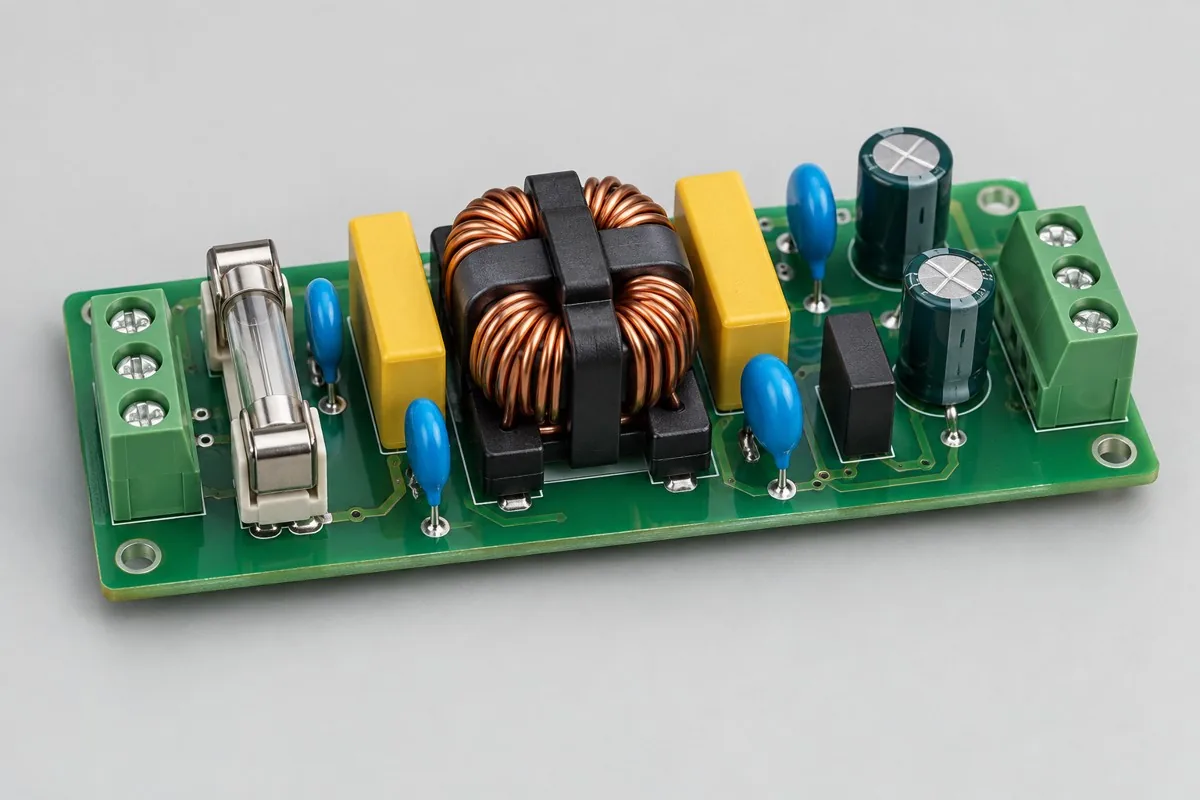
- Power filter through-hole board: common-mode chokes, fuses, and filter capacitors.
Return to through-hole assembly configuration comparison · Component Supply and Procurement · Testing and Delivery Scope
Material and Process Reference
- Engineering reference | SMT packages and assembly methods: pads, stencils, and thermal processes: a package/assembly method index only; not evidence that the product configurations on this page are models produced by KFPCBA
- Engineering reference | Soldering processes and defect isolation: wetting, residues, and solder oxidation: a reference entry for soldering, residues, and defect isolation methods only. Verify this page's soldering routes against specific materials/components